How to Drive in Fog: The Visibility Rules Most Drivers Get Wrong
Auto Roamer
12 min read
Includes Video
You're cruising down the highway, the sun just starting to dip, when suddenly you hit a wall of white. Visibility drops from miles to mere feet - maybe 50 feet, if you're lucky. Your first instinct, and the mistake most drivers make, is to slam on the high beams, hoping to pierce the gloom.
You're cruising down the highway, the sun just starting to dip, when suddenly you hit a wall of white. Visibility drops from miles to mere feet - maybe 50 feet, if you're lucky. Your first instinct, and the mistake most drivers make, is to slam on the high beams, hoping to pierce the gloom. Instead, you create a blinding whiteout, reflecting the light right back at you and making it impossible to see anything. This is where understanding how to drive safely in fog becomes critical. Many drivers get this wrong, often with disastrous results Caltrans. Driving too fast for conditions is a primary cause of fog-related collisions, which unfortunately have the highest fatality rates Caltrans. We need to talk about the correct use of headlights and fog lights, and critically, the speed you should be going.
The Short Answer
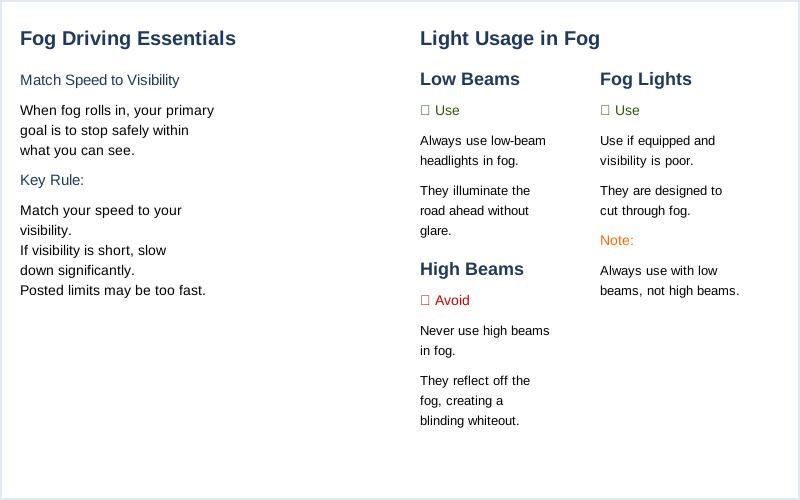
When fog rolls in, your primary goal is to ensure you can stop safely within the distance you can see. This means drastically reducing your speed and using your lights strategically to maximize visibility without creating more glare.
The most critical rule for driving in fog is to match your speed to your visibilityNational Weather Service. If you can only see a short distance ahead, you must slow down to a speed that allows you to stop completely within that range. This often means driving at speeds significantly lower than the posted limit. Nearly three in four fog-related collisions are linked to drivers going too fast for conditions Caltrans - CA.gov.
Always use your low-beam headlights when driving in fog. High beams are counterproductive because they reflect off the fog droplets, creating a "white wall" that actually reduces your visibility Firestone Complete Auto Care. If your vehicle is equipped with fog lights, use them in conjunction with your low beams. Fog lights are designed to cut under the fog layer and provide better illumination closer to the road surface Facebook.
If the fog becomes so dense that you can no longer see a reasonable distance ahead, the safest course of action is to pull over completely off the roadway and wait for conditions to improve. Do not stop on the shoulder of the freeway or highway, as this creates a hazard for other drivers. If you must pull over, ensure your vehicle is completely out of the travel lanes and turn on your hazard lights.
Don't rely solely on your headlights; use other cues. Utilize your windshield wipers and defroster to maintain clear visibility through the glass Safety+Health Magazine. Also, use the fog line on the right edge of the road as a guide. If you can, crack your window slightly to better hear approaching traffic you may not be able to see.
To enhance your fog driving skills, you might find valuable insights in our complete guide to driving in heavy fog.
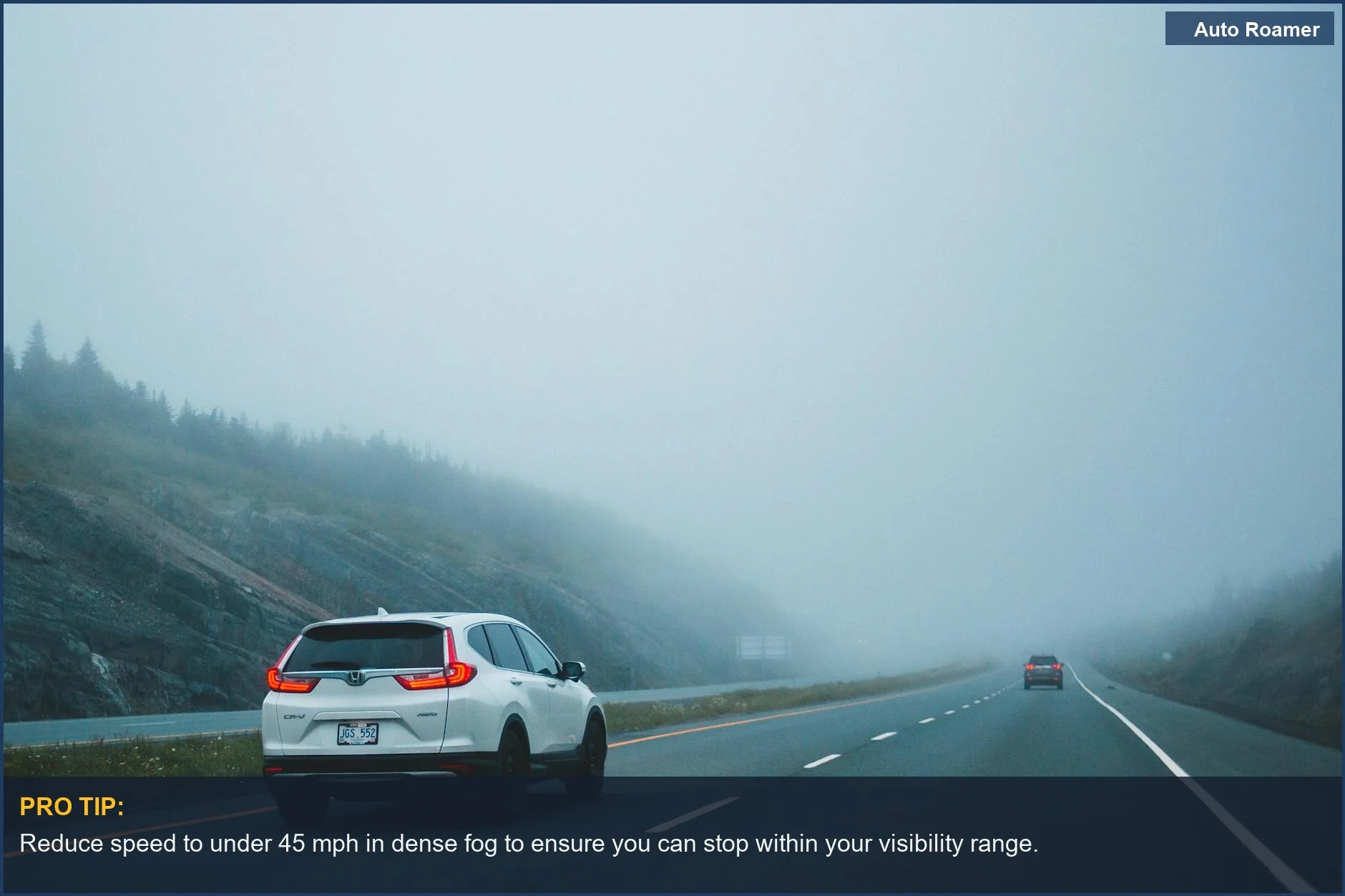
Navigating a foggy highway requires extreme caution. Visibility can drop to less than 50 feet, making slow, deliberate driving essential.
| Photo by Erik Mclean
Navigating a foggy highway requires extreme caution. Visibility can drop to less than 50 feet, making slow, deliberate driving essential.
| Photo by Erik Mclean
What You Need to Know
1
Reduce your speed significantly to ensure you can stop within the distance you can see. Nearly three in four fog-related collisions are linked to driving too fast for conditions, resulting in the highest fatality rates Caltrans - CA.gov. If visibility drops to a point where you can't see far ahead, it's time to pull over completely. Fog limits visibility to a quarter mile or less in dense conditions National Weather Service.
2
Use your low-beam headlights. High beams are counterproductive in fog because they reflect off water droplets, creating a "white wall" that further reduces visibility Firestone Complete Auto Care. Low beams, on the other hand, are designed to project light downwards and have a shorter range, which is more effective for seeing the road surface. If your vehicle is equipped with fog lights, activate them in conjunction with your low beams. Fog lights are designed to shine downwards and outwards, cutting under the fog layer Facebook. Never drive with only parking lights or fog lights on; always use your low beams as the primary light source Caltrans.
3
Increase your following distance substantially. The general rule of thumb is to triple your normal following distance. This gives you the necessary buffer to react and stop safely if the vehicle ahead brakes suddenly. Avoid using cruise control, as it can lead to maintaining an unsafe speed and reduce your reaction time Safety+Health Magazine. Stay alert and be prepared for slower-moving vehicles or even stopped vehicles.
4
Use the road's edge as a guide. The solid white line on the right shoulder, often called the "fog line," is your best friend for maintaining lane position. Highways prone to fog may have markers that follow a 3-2-1 countdown pattern to indicate upcoming exits Caltrans - CA.gov. Crack your window open slightly to better hear surrounding traffic you might not be able to see Caltrans - CA.gov.
5
Consider the specific environment. Fog is often worse near bodies of water, in valleys, and during the early morning hours Caltrans - CA.gov. These conditions can drastically reduce visibility to extremely low levels, making driving hazardous. If conditions become too severe and you cannot see adequately to drive safely, pull over to a safe location completely off the roadway until the fog lifts National Weather Service.
As you adjust your driving habits in low visibility, it's important to remember that using hazard lights in rain can also be problematic; learn more about this in our article on hazard lights in rain.
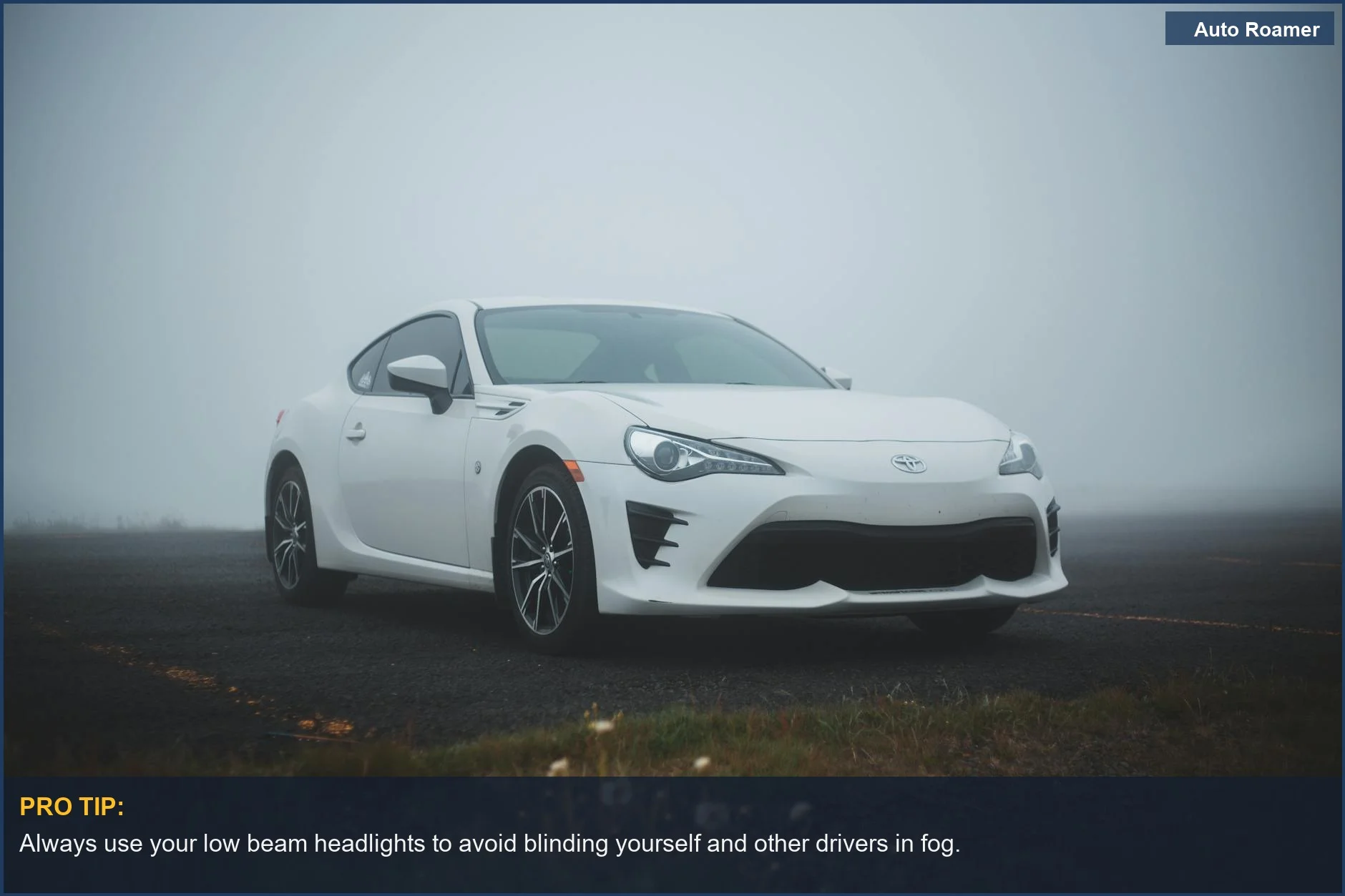
When driving in fog, a parked car like this highlights the limited visibility. Remember to switch to low beams immediately.
| Photo by Erik Mclean
When driving in fog, a parked car like this highlights the limited visibility. Remember to switch to low beams immediately.
| Photo by Erik Mclean
How to Handle This
1
Switch to low beams immediately - This is non-negotiable. High beams in fog are worse than useless; they create a blinding white wall by reflecting off the water droplets, severely reducing your already limited visibility Firestone Complete Auto Care. If your car's headlights are on auto, manually switch them to the ON position.
2
Engage fog lights if your vehicle has them - Fog lights are designed to cut under the fog layer, providing a lower, wider beam than standard headlights Facebook. Use them in conjunction with your low beams for maximum visibility. Never use only parking lights or fog lights alone, and remember to turn your fog lights off when visibility improves to avoid dazzling other drivers.
3
Reduce speed to stop within your sight distance - This is the single most critical step for driving in fog safely. You must be able to stop your vehicle completely within the distance you can clearly see ahead. Many fog-related collisions occur because drivers are traveling too fast for conditions Caltrans. If you can only see a short distance ahead, your speed should be correspondingly low.
4
Use the right edge line as your primary guide - Don't fixate on the center line; it can be misleading in fog, especially on winding roads. Instead, use the solid white line on the right shoulder, often called the "fog line," as your guide Caltrans. This helps you stay in your lane and avoid drifting into oncoming traffic or off the road.
5
Crack your window to listen for traffic - Your ears can become as important as your eyes in dense fog. Lowering a window allows you to better hear approaching vehicles, especially those you can't see, helping you anticipate potential hazards at intersections or when changing lanes Caltrans.
Once you've fixed the chip, you might want to learn how to defog your windshield fast for clearer visibility.
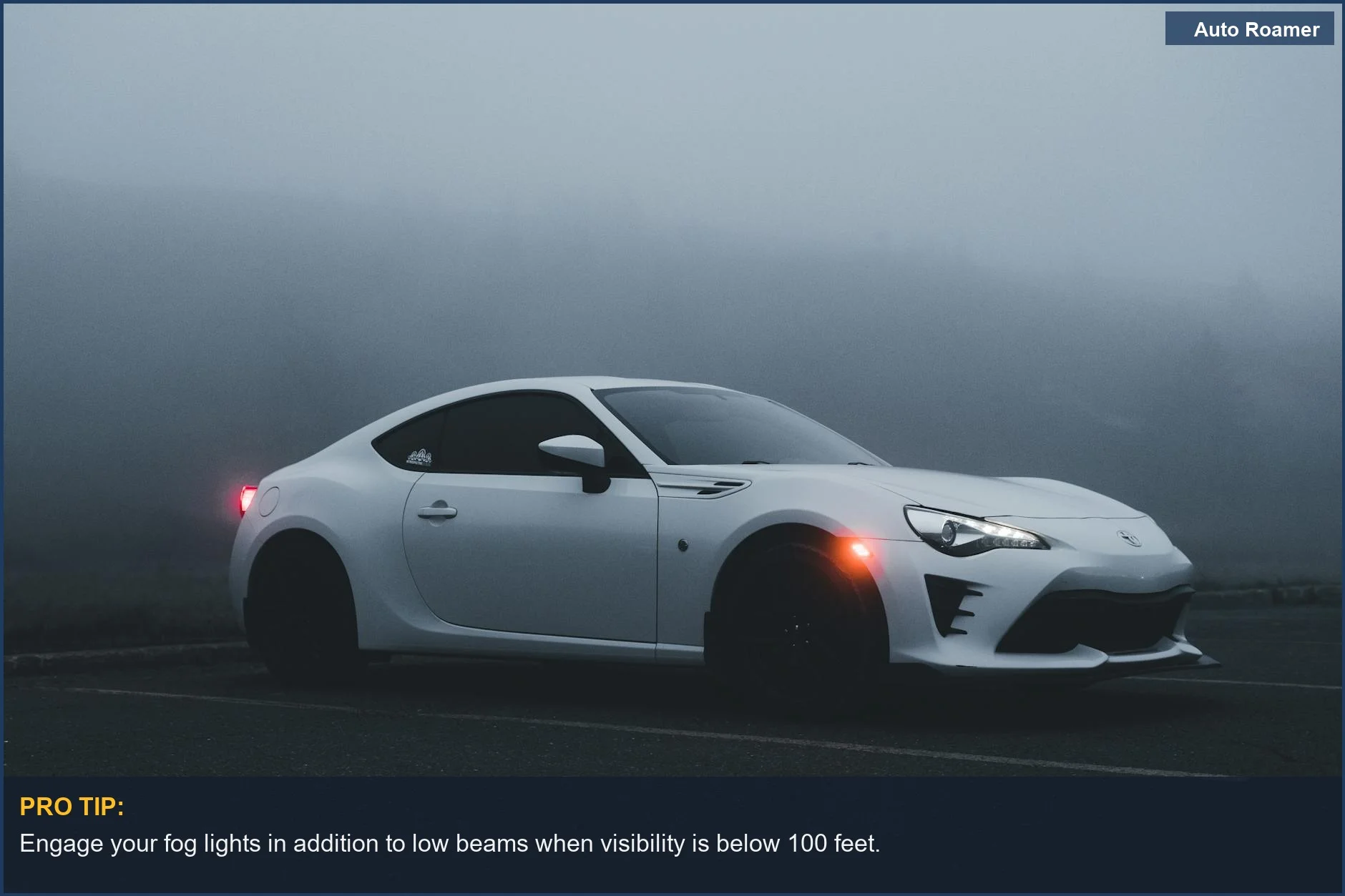
This modern car in fog sets a mood, but in reality, drivers need to focus on safety. Utilize fog lights for better visibility.
| Photo by Erik Mclean
This modern car in fog sets a mood, but in reality, drivers need to focus on safety. Utilize fog lights for better visibility.
| Photo by Erik Mclean
What This Looks Like in Practice
This is what poor fog driving looks like in practice, based on real-world reports and official guidance.
Highway Fog in a Mid-Size Sedan: We were cruising down the interstate, visibility reduced to just a few car lengths. A common mistake is maintaining normal highway speeds, but we saw cars behind us still traveling at a pace that felt dangerously fast given the conditions Caltrans. The correct approach is to significantly reduce speed, aiming to stop within the distance you can see, and use your low beams Safety+Health Magazine.
Mountain Pass in a Compact SUV: Navigating winding mountain roads in dense fog is terrifying. You can't see the curves ahead, making it impossible to anticipate turns or dropped shoulders. This is where maintaining a very slow, controlled speed is paramount, and using the fog line on the right shoulder becomes your only reliable guide Caltrans.
Coastal Highway at Night in a Pickup Truck: This is the worst-case combination. Darkness amplifies the disorientation of fog, making it incredibly difficult to judge distances or see obstacles. Even with low beams and fog lights on, seeing more than a short distance ahead is a challenge. We found it essential to avoid passing and to be hyper-aware of the shoulder markers to stay on the road National Weather Service.
Freezing Fog on Rural Roads in a Hatchback: When fog freezes on contact, it coats windshields and roads with a slick layer of ice. This creates a double hazard: reduced visibility and treacherous driving surfaces. We learned the hard way that even at slow speeds, braking and steering become unpredictable. Using your defroster and wipers aggressively is key, but if ice builds up, it's safer to pull over entirely.
Just as fog can obscure visibility, heavy rain presents its own challenges, so understanding how to drive in heavy rain safely is essential.
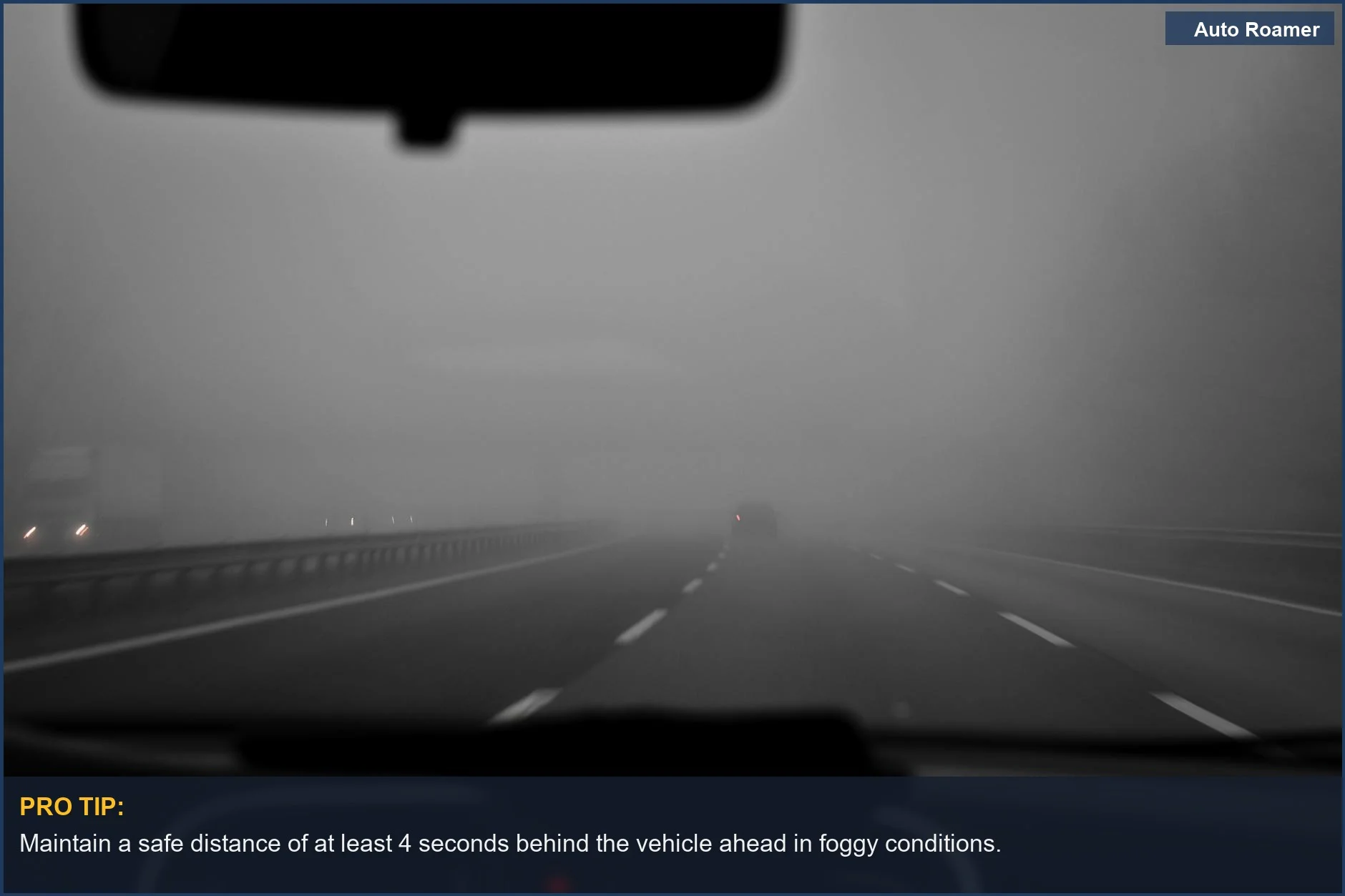
Driving from within a car on a foggy highway reveals the stark reality of reduced visibility. Follow fog driving tips to stay safe.
| Photo by Abdulvahap Demir
Driving from within a car on a foggy highway reveals the stark reality of reduced visibility. Follow fog driving tips to stay safe.
| Photo by Abdulvahap Demir
Mistakes That Cost People
Symptom You're driving in fog and suddenly can't see more than a car length ahead.
Signal Your headlights are set to high beam.
Fix Immediately switch to low beams. High beams reflect off the fog droplets, creating a blinding white wall that drastically reduces your visibility Driving in Fog: High Beams or Low Beams?. Low beams are designed to go only about 200 feet, which is crucial when visibility is this low Driving in Fog: High Beams or Low Beams?.
Symptom You're driving in fog, and the car behind you is tailgating, pressuring you to speed up.
Signal You're maintaining a speed that feels safe but is faster than your visibility allows you to stop.
FixDo not increase your speed to match the tailgater. Your priority is to be able to stop within the distance you can see. Caltrans notes that nearly three in four fog-related collisions are due to drivers going too fast for conditions Safe Driving Tips for Foggy Conditions - Caltrans - CA.gov. If they're too close, let them pass if it's safe, or be prepared to brake gently and defensively.
Symptom You need to pull over because the fog is too dense to continue driving.
Signal You're considering stopping on the shoulder of the highway.
FixNever stop in a travel lane or on the shoulder of a freeway or highway if you can avoid it. This creates a dangerous hazard for other drivers who may not see you until it's too late Safe Driving Tips for Foggy Conditions - Caltrans - CA.gov. Instead, pull off the road completely at the next exit or a designated rest stop. If you absolutely must stop on the shoulder, turn on your hazard lights and get as far off the road as possible.
Symptom You're following another vehicle in fog and can only see its taillights.
Signal You're maintaining a close following distance, assuming the taillights mean the car is moving at a safe speed.
FixDrastically increase your following distance. The taillights are your only indicator of the car ahead, but they don't tell you how far away it is or how fast it's going. You need to be able to stop within the distance you can see, which is significantly reduced in fog Social Media: Fog Safety - National Weather Service. Double your normal following distance, or more.
Symptom It's daytime, visibility is poor due to fog, but you don't turn on your headlights.
Signal Your headlights are in the "auto" position, or you believe your car is visible enough without them.
Symptom You have a vehicle with advanced driver-assistance systems (ADAS) like adaptive cruise control or automatic emergency braking.
Signal You're relying on these systems to manage speed and braking in fog.
FixDo not rely solely on ADAS features in dense fog. Sensors like cameras and radar can be severely impaired by fog, leading to system malfunctions or failure to detect hazards Driving in Severe Weather - NHTSA. These systems are designed for clearer conditions. You must drive manually and be extra vigilant.
Just as fog can obscure your view, black ice presents its own set of challenges, so it’s important to know how to drive on black ice.
Comparison overview for how to drive safely in fog including when to use low beams fog lights and what speed
Key Takeaways
When visibility drops, slow down and adjust your speed so you can stop within the distance you can see. This is the single most critical rule for driving in fog.
If you find yourself in dense fog where you cannot see clearly, pull over entirely to a safe location, off the travel lanes. Don't risk overdriving your visibility or becoming a hazard to others Social Media: Fog Safety - National Weather Service.
To enhance your car's overall appearance, don't forget to also tackle those cloudy headlights with our tips on cleaning foggy headlights.
Frequently Asked Questions
High beams or low beams in fog?
Always use your low beams in fog. High beams actually reflect off the fog and can make it harder to see, creating a glare. We learned this the hard way on a trip through the Central Valley when the fog rolled in thicker than pea soup. Low beams are designed to shine closer to the ground and are your best bet for visibility. Some vehicles also have fog lights, which are an excellent addition to low beams when visibility is severely reduced.
How slow should you drive in fog?
There's no single speed, but the general rule is to drive slow enough to stop within the distance you can see. We've found that often means 10-20 mph below the posted speed limit, sometimes even slower. Caltrans statistics show nearly three in four fog-related crashes are due to driving too fast for conditions Source Name. If you can't see more than a car length ahead, you're going too fast.
Are fog lights required by law?
Most places don't legally require fog lights, but they are incredibly helpful when visibility drops. They're designed to shine down and spread out, illuminating the road surface closer to your vehicle, unlike headlights. If your car has them, use them in conjunction with your low beams when fog is dense; they are not meant to replace headlights entirely Source Name.
Most dangerous type of fog for driving?
Dense fog, often called Tule fog in places like California's Central Valley, is the most dangerous. It can reduce visibility to a quarter-mile or less Source Name. This is where the risk of chain-reaction collisions dramatically increases because drivers can't see stopped vehicles ahead in time. We've experienced this firsthand and had to pull over because the visibility was near zero.
Should you pull over in dense fog?
If visibility becomes so poor that you can't safely see the road ahead, pulling over is the safest option. Find a safe spot completely off the roadway, turn off your driving lights (so others don't mistake you for a moving vehicle), and turn on your hazard lights Source Name. We've had to do this on mountain passes when the fog was so thick we couldn't even see the edge of the road.