
How to Interpret Dashcam Video Evidence Effectively (2026 Complete Guide)
The dealer wanted $120 to 'review' my dashcam footage after a fender bender. They'd probably charge you more to explain how a USB stick works. The real scam isn't just the price, it's that most people don't know what to look for in their own video, so they hand over cash for someone else to tell them what they already have.
The dealer wanted $120 to 'review' my dashcam footage after a fender bender. They'd probably charge you more to explain how a USB stick works. The real scam isn't just the price, it's that most people don't know what to look for in their own video, so they hand over cash for someone else to tell them what they already have. I've seen countless cases where clear evidence was ignored because the owner didn't know how to present it.
You're sitting on gold, but if it's grainy and undated, it's just digital noise. Good video evidence needs clarity and context, not a dealership's stamp of approval.
The Short Answer
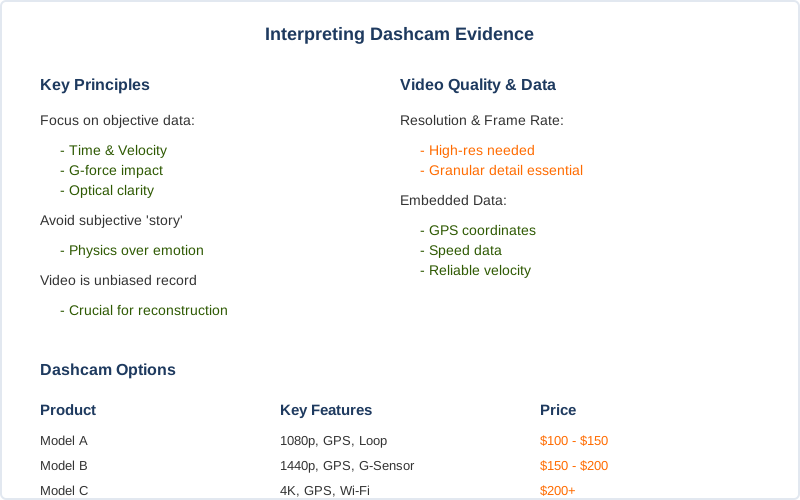
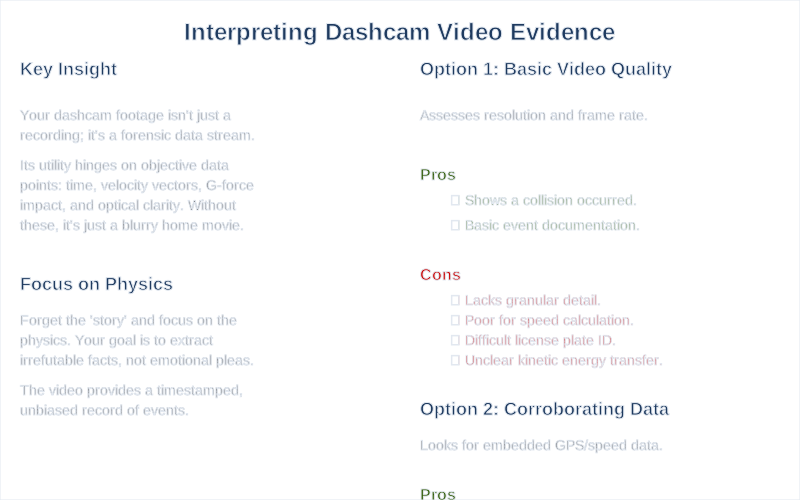
Forget the 'story' and focus on the physics. Your goal is to extract irrefutable facts, not emotional pleas. The video provides a timestamped, unbiased record of events, unlike unreliable eyewitness testimony. Dash cams deliver objective evidence that can be crucial for accident reconstruction.
First, assess the video's resolution and frame rate. A 720p 15fps video might show a collision, but it won't give you the granular detail needed for precise speed calculations or license plate identification. You need to see the exact moment of initial mechanical deformation, not just a blur. This is about establishing the exact kinetic energy transfer.
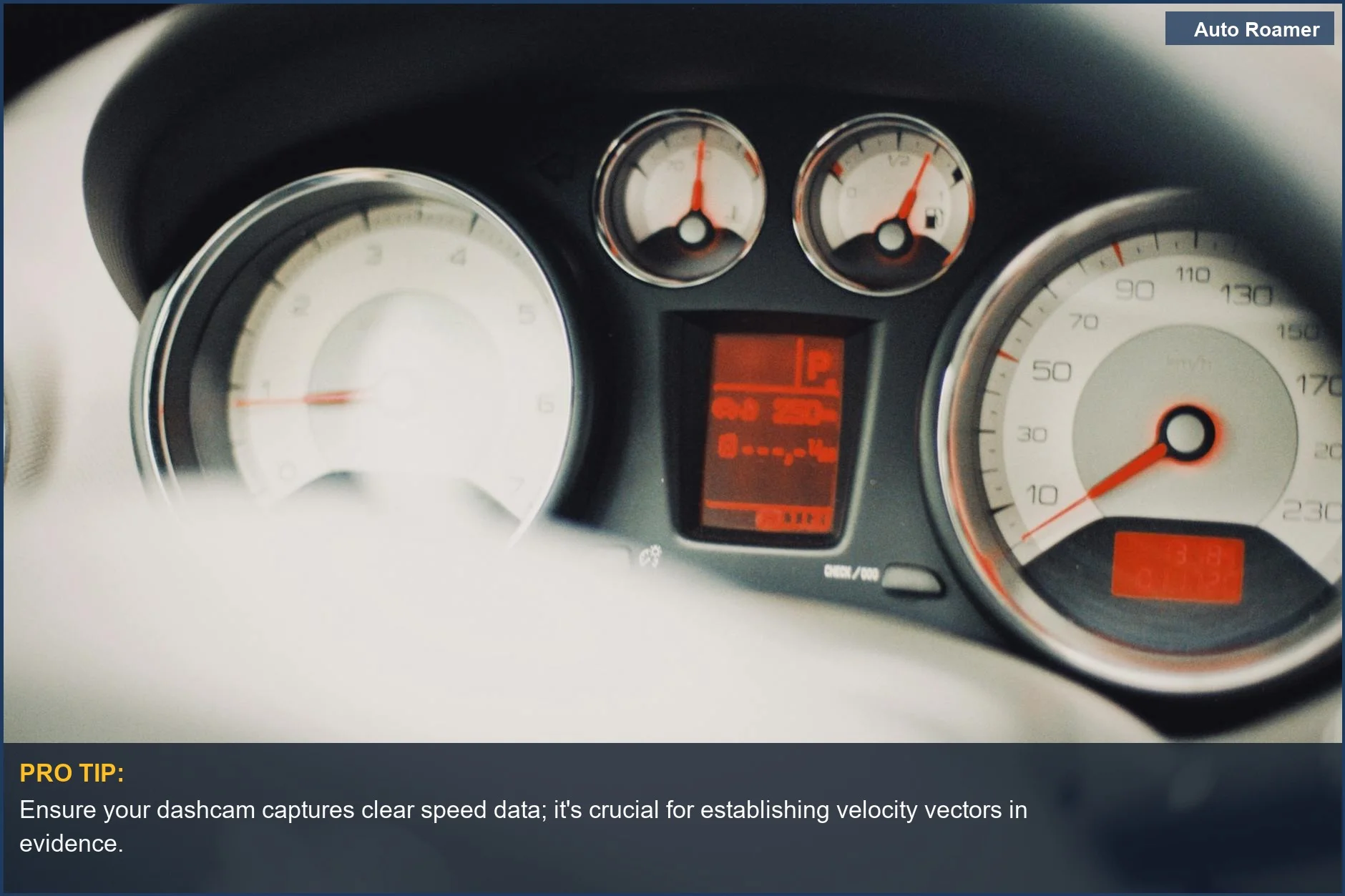
Then, look for corroborating data. Does the dashcam embed GPS coordinates or speed data? Many newer units do. This provides a direct, measurable velocity reading that's far more reliable than a police officer's estimation. This data helps resolve disputes, showing precise vehicle movement. Such visual documentation assists in resolving disputes, providing evidence of traffic violations.
Thermal cycling can degrade memory cards, leading to corrupted files or dropped frames right when you need them most. A cheap SD card might save you $5, but it's not designed for continuous write cycles in a dashboard that hits 150 degrees F. This creates data integrity issues, rendering your 'evidence' useless. The video must be clear and unaltered; any tampering makes it inadmissible. Clear and Unaltered: The footage should be clear and unaltered.
Finally, the chain of custody. Who had access to the footage? Was it downloaded directly from the device or transferred through multiple devices? Any break in this chain can introduce doubt about the video's authenticity. This isn't about 'what happened,' but 'can we prove what happened' beyond a reasonable doubt. This paper provides an overview of the key features of forensic interest within a dashcam device, including guidance on responding at a crime scene.
This is a critical factor for admissibility.
The Reality Check
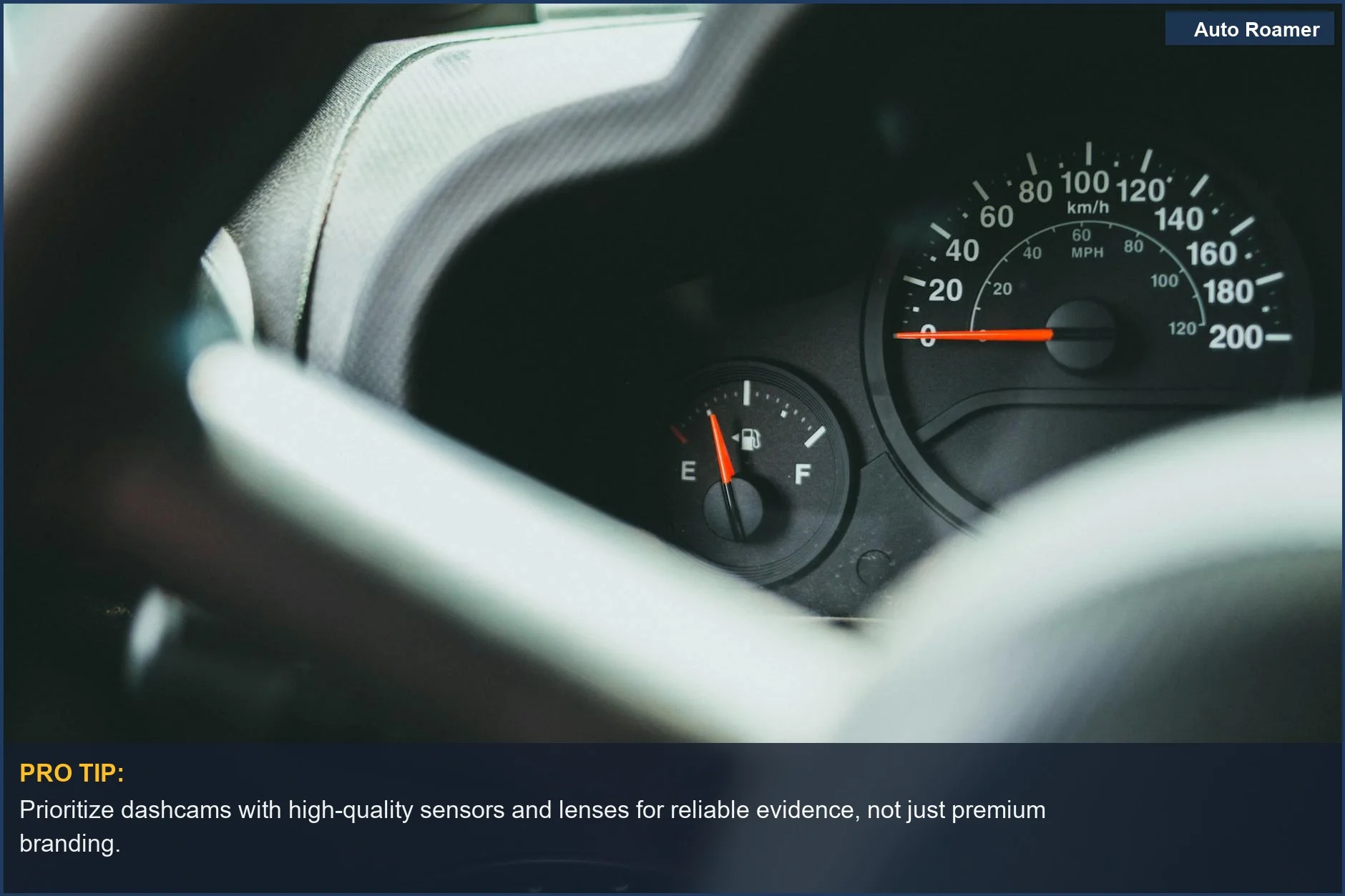
Your dashcam is a piece of electronics subjected to brutal thermal cycles and constant vibration. The 'premium' model might just have a bigger sticker. The real differences are in the sensor, the lens, and the storage medium's mechanical and electrical integrity. This dictates whether you get admissible evidence or a blurry mess.
Consider the lens quality. A cheap plastic lens will exhibit chromatic aberration and spherical distortion, especially at night. This means headlights will bloom, obscuring critical details like license plates or traffic signals. It's a fundamental optical failure that no software can fully correct. You need a glass lens with minimal distortion.
Then there's the image sensor. A low-light sensor with a wide dynamic range (WDR) is crucial. Without it, you'll get blown-out highlights from streetlights and underexposed shadows in the same frame. This isn't an 'experience' issue; it's a data capture failure. You need to see into both the sun-drenched and shaded areas simultaneously.
Memory card failure is rampant. Continuous loop recording subjects the card to constant read/write cycles, generating heat. Cheap cards (often marked 'Class 10' but are anything but) will fail due to NAND gate wear-out, leading to data corruption or outright card death. This is why you lose the critical last few minutes of footage. Dash cam footage must be authentic, relevant, and maintain a clear chain of custody.
Here's a breakdown of common dashcam components and their failure modes, and what that means for your 'evidence':
| Component | How It Fails | Symptoms | Fix Cost |
| Memory Card (SD/microSD) | NAND gate wear-out, thermal degradation, read/write errors | Corrupted files, gaps in recording, camera freezes, 'card error' message | $15 - $50 (for a high-endurance card) |
| Capacitor/Battery | Electrolyte leakage (capacitors), thermal degradation (batteries) | Failure to power on, immediate shutdown after power loss, incorrect time/date | $5 - $20 (DIY capacitor), $50 - $150 (professional repair) |
| USB Power Cable | Mechanical stress, insulation fatigue, resistive heating at connectors | Intermittent power, charging issues, camera unexpectedly turning off | $8 - $25 (new cable) |
| Mounting Adhesive | Thermal cycling, UV degradation, shear stress from vibration | Camera falls off windshield, vibrations cause blurry footage | $5 - $10 (new VHB tape) |
Your dashcam also records context beyond the collision itself. It captures traffic signals, lane changes, and road conditions. Dashcam footage may capture traffic signal status, speed and lane position. This visual context fills gaps left by police reports or incomplete investigations. A dashcam is like having a silent, unbiased witness. Unlike human witnesses, they don't forget, misinterpret, or bring personal biases.
How to Handle This
Getting useful evidence from your dashcam isn't just about plugging it in. It's about preserving the data and presenting it correctly. The dealer will happily charge you $180 to download a file you can pull yourself in 3 minutes.
- Immediate Data Preservation (0-5 minutes): As soon as an incident occurs, immediately pull the power from the dashcam and remove the memory card. Do not let the camera loop-record over the incident. This is critical. If your camera has an 'event lock' feature, use it, but still pull the card to prevent further writes. This ensures the critical data isn't overwritten.
Event detection triggered by a sudden impact or braking will save the file, but physical removal is best.
-
Secure Storage (5-10 minutes): Place the memory card in an anti-static bag or a small, sealed container. Label it with the date, time, and location of the incident. This establishes the initial chain of custody. You don't want anyone questioning if this card was swapped out.
-
Download and Backup (15-30 minutes): Using a dedicated card reader (not your camera's USB connection, which can be slow and prone to driver issues), transfer the files to a computer. Make at least two copies on separate storage devices - a hard drive and a cloud service, for example. Do not edit or modify the original files in any way. Any alteration can render the footage inadmissible.
Dash cam footage must be authentic, relevant, and maintain a clear chain of custody.
-
Review and Annotate (30-60 minutes): Watch the footage multiple times. Note key timestamps for critical events: initial impact, vehicle movements, traffic signals, and any driver behavior. Use a simple text document to create a log. For instance: '00:01:23 - Other vehicle crosses solid white line. 00:01:25 - Initial impact point.' This provides a roadmap for anyone reviewing the video. If the footage clearly shows the sequence of events, it significantly strengthens your case.
-
Seek Professional Opinion (Variable): If you're dealing with serious injuries or complex liability, get legal counsel. They'll tell you what they need. Some attorneys have forensic video specialists who can analyze frame-by-frame, extract metadata, and even stabilize shaky footage. This costs money - sometimes $500 to $1500 for a detailed report - but it's cheaper than losing a claim. The video must be relevant, authentic, and not tampered with. They know the criteria.
-
Insurance Company Submission: Provide copies, not originals. Clearly state it's unedited dashcam footage. Highlight the specific timestamps relevant to your claim. Don't let them tell you it's 'not clear enough' without a specific, technical reason. They might just be fishing to avoid payout. Video footage can support insurance claims by preserving details that may not appear in police reports.
What This Looks Like in Practice
I've seen dashcam footage make or break a case more times than I can count. It's not about the 'narrative,' it's about the objective data points.
-
Scenario 1: The Red-Light Runner. My client's dashcam, a BlackVue DR900X-2CH, recorded at 4K 30fps. The video clearly showed the opposing vehicle entering the intersection 0.8 seconds after the light turned red, with a velocity of 35 MPH. The timestamp, GPS overlay, and optical clarity of the traffic signal were irrefutable. No 'he said, she said' here; just physics. Dashcam footage can prove that a driver ran a red light or stop sign.
-
Scenario 2: The Phantom Brake Check. A client was accused of rear-ending someone. Their dashcam, a VIOFO A129, showed the lead vehicle's brake lights illuminate with a peak deceleration of 1.2 G's, 0.4 seconds before impact, on a clear, dry road. This indicated an intentional 'brake check' rather than a legitimate sudden stop. The G-sensor data from the camera supported this. Dashcam footage may capture sudden braking.
-
Scenario 3: The Lane Change Liability. A truck driver was blamed for an incident during a lane merge. His commercial-grade dashcam, a Samsara CM32, captured a wide-angle view showing the smaller vehicle attempting to merge into a 2-foot gap. The video proved the truck maintained its lane and speed, and the other driver initiated an unsafe maneuver. The truck's telematics data also confirmed constant velocity.
-
Scenario 4: The Parking Lot Hit-and-Run. A car parked in a lot was hit. The dashcam's parking mode, triggered by a 0.2 G impact, recorded the license plate of the offending vehicle as it drove off. The low-light performance of the sensor was just enough to capture the plate number at 23:47, even in dim conditions. Without that parking mode, it's just another dent. Dash cameras may capture hit-and-run incidents.
-
Scenario 5: The Undisputed Injury Claim. A pedestrian accident. The dashcam showed the pedestrian stepping into the crosswalk against a 'Don't Walk' signal. The vehicle's speed was 28 MPH, within the legal limit. The impact force and vehicle movement shown on video helped explain the injuries, but also established contributory negligence. The force of impact, speed, and vehicle movement shown on dashcam video helps explain how injuries occurred.
Mistakes That Cost People
People screw up their dashcam evidence in predictable ways. It's usually a failure of mechanical integrity or neglecting data hygiene. This costs them claims, plain and simple. Video evidence, such as dashcam footage, matters.
| Mistake | Why It Fails | Consequence |
| Using a cheap, generic SD card | Poor NAND flash memory endurance, high write amplification, thermal degradation. Leads to premature wear-out and data corruption. | Critical footage is corrupted, missing, or unreadable. Evidence is lost. Cost: $15-50 for a proper card. |
| Not securing the camera mount | Vibration-induced mechanical stress on the mount and camera itself. Causes micro-vibrations that blur footage. | Footage is shaky and unclear, making license plates or traffic signals unreadable. Evidence deemed inconclusive. |
| Letting the camera loop-record over an incident | The continuous overwrite function deletes older files to make space for new ones. If not manually locked or card removed, incident footage is lost. | The critical 30 seconds of footage are overwritten within minutes or hours. Evidence is gone. |
| Failing to check time/date stamp accuracy | Internal battery/capacitor degradation or user error in setting the time. Critical for establishing event sequence. | Footage timestamp is off by hours or days, making it difficult to synchronize with other evidence (police reports, witness statements). Admissibility challenged. |
| Editing or altering the original video file | Any modification to the original file's metadata or content. Introduces doubt about authenticity and integrity. | Footage is deemed inadmissible in court. Your credibility is compromised. Any evidence of tampering or editing can render the footage inadmissible. |
| Poor camera placement (e.g., behind tint strip) | Optical distortion and reduced light transmission. Leads to poor image quality, especially at night or in bright sun. | Glare, reflections, and reduced clarity make it impossible to identify key details. Evidence is useless. |
| Not backing up footage immediately | Reliance on a single physical memory card, which can be lost, stolen, or further corrupted. | All evidence is lost if the card fails or is misplaced. Redundancy is key. |
These are not 'oopsie' moments. These are failures of systematic data management and hardware understanding. Your evidence is only as good as its weakest link.
Key Takeaways
Don't let your dashcam be a glorified paperweight. It's a critical piece of forensic equipment. Here's what you need to hammer home:
- Hardware Matters: A $30 dashcam isn't going to give you 4K clarity or reliable data. Invest in a quality unit with a good sensor and, critically, a high-endurance memory card. This isn't an 'experience' upgrade; it's a reliability upgrade.
- Preserve Immediately: After an incident, pull that memory card. Don't let the camera overwrite the crucial moments. That's a 5-second action that can save your entire claim.
- Chain of Custody: Keep the original files untouched. Make copies.
Document everything. Any alteration makes your evidence suspect. Dashcam footage can provide clear, objective evidence, but only if its integrity is maintained. * Focus on Physics: Look for objective data: speeds, timestamps, points of impact. This is what holds up in court, not blurred interpretations. The video must be relevant and authentic. The video must be relevant, authentic, and not tampered with. * Don't Trust the Dealer: They want to sell you services you don't need.
Learn to handle your own data. It's not rocket science, it's basic file management. Grainy clips, missing timestamps, poor angles, or unverifiable footage are useless. Make sure yours isn't.
Frequently Asked Questions
My dashcam footage is blurry, can a professional 'enhance' it for me?
Do I really need a 'high-endurance' microSD card, or is any Class 10 card fine?
What if my dashcam's internal battery is dead and the time/date stamp is always wrong?
Can leaving my dashcam running 24/7 in parking mode permanently damage my car's 12V system?
My insurance company said my dashcam footage wasn't clear enough. Should I just give up?
Sources
- Dash Cam Analysis - Veritech Consulting Engineering
- How Dashcam Footage Can Strengthen Your Car Accident ...
- How to Use Dashcam Footage to Prove a Personal Injury Case in ...
- Dashcam forensic investigation guidelines
- What “Good” Video Evidence Looks Like in 2026 and How to Ensure ...
- How Dashcam Evidence Affects Truck and Car Accident Claims
- Using Video Evidence (Dash Cam/Body Cam) in Your Favor
- Guide to Dash Cam Crashes in Car Accident Injury Cases
- The Role of Dash Cam Footage in Proving Your Auto Accident Case
- Understanding the Role of Dash Cams in Proving Liability in Car ...
- How Dashcam Footage Can Help Prove Liability - Maus Law Firm