That sudden braking from the car in front, the swerve to avoid a pothole - you just experienced a near-miss. Were you at fault? Was the other driver? Without a clear record, sorting out the truth after an accident or incident can turn into a frustrating, expensive battle.
That sudden braking from the car in front, the swerve to avoid a pothole - you just experienced a near-miss. Were you at fault? Was the other driver? Without a clear record, sorting out the truth after an accident or incident can turn into a frustrating, expensive battle. This is precisely why a robust dash camera policy is no longer optional for businesses operating vehicles. It's about protecting your drivers, your assets, and your bottom line. A well-defined policy ensures everyone understands the purpose of these devices and how the collected data will be used, turning potential chaos into actionable insights How to Create a Dash Cam Policy. This isn't just about catching bad drivers; it's about exonerating good ones and improving overall safety on the road Dash Camera Policies. Establishing these guidelines upfront prevents disputes and ensures compliance.
The Short Answer
A dash camera policy is non-negotiable for any fleet or organization using these devices. It's the bedrock for managing expectations, ensuring legal compliance, and maximizing the safety and accountability benefits of dash cams.
The core purpose of a dash camera policy is to clearly define why these systems are implemented, typically for accident investigation, dispute resolution, and improving driver behavior Dash Camera Policies. Without this framework, you risk legal challenges and driver mistrust. The policy must detail driver responsibilities, such as reporting malfunctions and never tampering with the equipment or data. It also needs to explicitly state that all data and video are the sole property of the companyHow to Create a Dash Cam Policy.
Equally crucial are supervisor responsibilities, outlining how data will be reviewed, how unsafe driving behavior will be addressed through coaching, and how safe driving will be rewarded. This ensures a consistent and fair approach to using the collected footage Dash Camera Policies. Remember, telematics-based systems are a significant investment, and a well-structured policy is key to realizing their full potential in reducing accidents Dash Camera Policies.
When drafting your policy, pay close attention to privacy implications, especially with in-cab cameras. Understand state-specific laws regarding consent for audio and video recording. Consulting legal experts is vital to navigate these complexities and ensure compliance, preventing potential lawsuits and fines Dash Cams & Privacy: Employer and Driver Guide for 2025. The policy should clearly define the scope of data collection and how it will be used.
A comprehensive dash cam policy helps drivers understand how their actions are monitored and how video footage can ultimately protect them. It's about establishing clear guidelines and expectations for everyone involved, ensuring the technology serves its intended purpose of enhancing safety and accountability across the fleet How to Create a Dash Cam Policy.
Understanding dash camera policies is crucial, especially in light of the evolving dash cam laws that govern their use.
A detailed view of a car's dashboard highlights the technology that requires a comprehensive dash camera policy for effective fleet management.
| Photo by Alexey Demidov
A detailed view of a car's dashboard highlights the technology that requires a comprehensive dash camera policy for effective fleet management.
| Photo by Alexey Demidov
What You Need to Know
1
Define the Purpose - Clearly state why you're implementing a dash camera policy. This isn't just about recording; it's about enhancing safety, accident investigation, and potentially reducing insurance costs. Mentioning benefits for both the company and drivers upfront builds trust. For instance, footage can exonerate drivers in false claims, acting as a crucial digital witnessHow to Create a Dash Cam Policy.
2
Outline Driver Responsibilities - Drivers need to understand their role. This includes reporting any system malfunctions immediately and never tampering with the camera. Actions like shutting off the device, blocking the lens, or removing storage cards are strictly prohibited without supervisor approval. Emphasize that all captured data and video are company property and drivers should not save or share it independently Dash Camera Policies.
3
Address Supervisor Duties - Supervisors play a critical role in managing the dash cam system. Their responsibilities include training drivers, ensuring drivers acknowledge the policy, and actively using the data for driver coaching and rewarding safe behavior. They must also have a clear protocol for responding to unsafe driving alerts and handling any driver concerns How to Create a Dash Cam Policy.
4
Navigate Privacy and Legalities - This is where things get tricky. Privacy laws vary significantly by state, especially concerning in-cab recording. While outward-facing cameras are generally accepted for road incident capture, interior cameras raise privacy concerns. Some states require explicit driver consent for in-cab audio and videoDash Cams & Privacy: Employer and Driver Guide for 2025. Always consult legal counsel to ensure compliance, particularly in states like California or Illinois which have stricter regulations. For example, a dash camera policy must clearly define what is recorded and how that data is accessed and used.
5
Consider Vehicle-Specific Needs - The type of vehicle impacts dash cam placement and functionality. For sedans and smaller SUVs, a standard forward-facing camera is often sufficient. However, larger trucks, vans, and commercial vehicles might benefit from multi-lens systems covering blind spots or interior monitoring for driver behavior, especially if the policy dictates such surveillance. Ensure the chosen hardware is appropriate for the vehicle's size and operational environment Fleet Dash Cam Guide: Enhancing Safety and Efficiency.
While dash cams offer many benefits, it's important to be aware of potential issues by exploring common dash cam problems.
The sophisticated interior of a luxury vehicle underscores the importance of a well-defined dash camera policy for company-owned cars.
| Photo by Izaz Ali
The sophisticated interior of a luxury vehicle underscores the importance of a well-defined dash camera policy for company-owned cars.
| Photo by Izaz Ali
How to Handle This
1
Define Data Ownership and Access - Clearly state that all dash cam data, including video and audio, is the sole property of the companyNationwide. Specify who can access this data (e.g., supervisors, accident investigators) and under what circumstances. This prevents unauthorized sharing or misuse of footage, which can lead to privacy violations or legal disputes. Without this, drivers might assume they have rights to the footage, leading to conflicts or the accidental disclosure of sensitive information.
2
Outline Driver Responsibilities and Prohibitions - Instruct drivers to immediately report any system malfunctions to their supervisor. They must not tamper with the device, including shutting it off, blocking the lens, or removing the storage card. This is critical because a malfunctioning camera provides no protection or data during an incident. If a driver disables the camera, especially during adverse weather like heavy fog or blinding sun, and an accident occurs, the footage will be unavailable, potentially shifting blame unfairly.
3
Establish Clear Use for Accident Investigation and Training - Detail how footage will be used to investigate accidents and coach drivers. This includes reviewing footage for unsafe driving behaviors like speeding or distracted driving, as well as for validating claims after an incident. Without this, drivers may fear the cameras are solely for punitive measures. For example, if a driver is rear-ended at night in a poorly lit rural area, the dash cam footage can definitively prove they were not at fault, saving significant time and hassle with insurance and legal claims. Conversely, footage can identify recurring issues like harsh braking in heavy city traffic, allowing for targeted training Mix Telematics.
4
Address Privacy Concerns and Consent Requirements - Research and comply with state-specific laws regarding in-cab recording and consentSafetyTrack. While external-facing cameras are generally accepted, internal cameras capturing driver behavior often require explicit consent. Failing to obtain proper consent for in-cab recording can lead to significant legal penalties and erode driver trust. This is especially important in states with strict privacy laws, where recording conversations or private actions without awareness can result in lawsuits.
Understanding the essential dash cam features can greatly enhance your experience before installation.
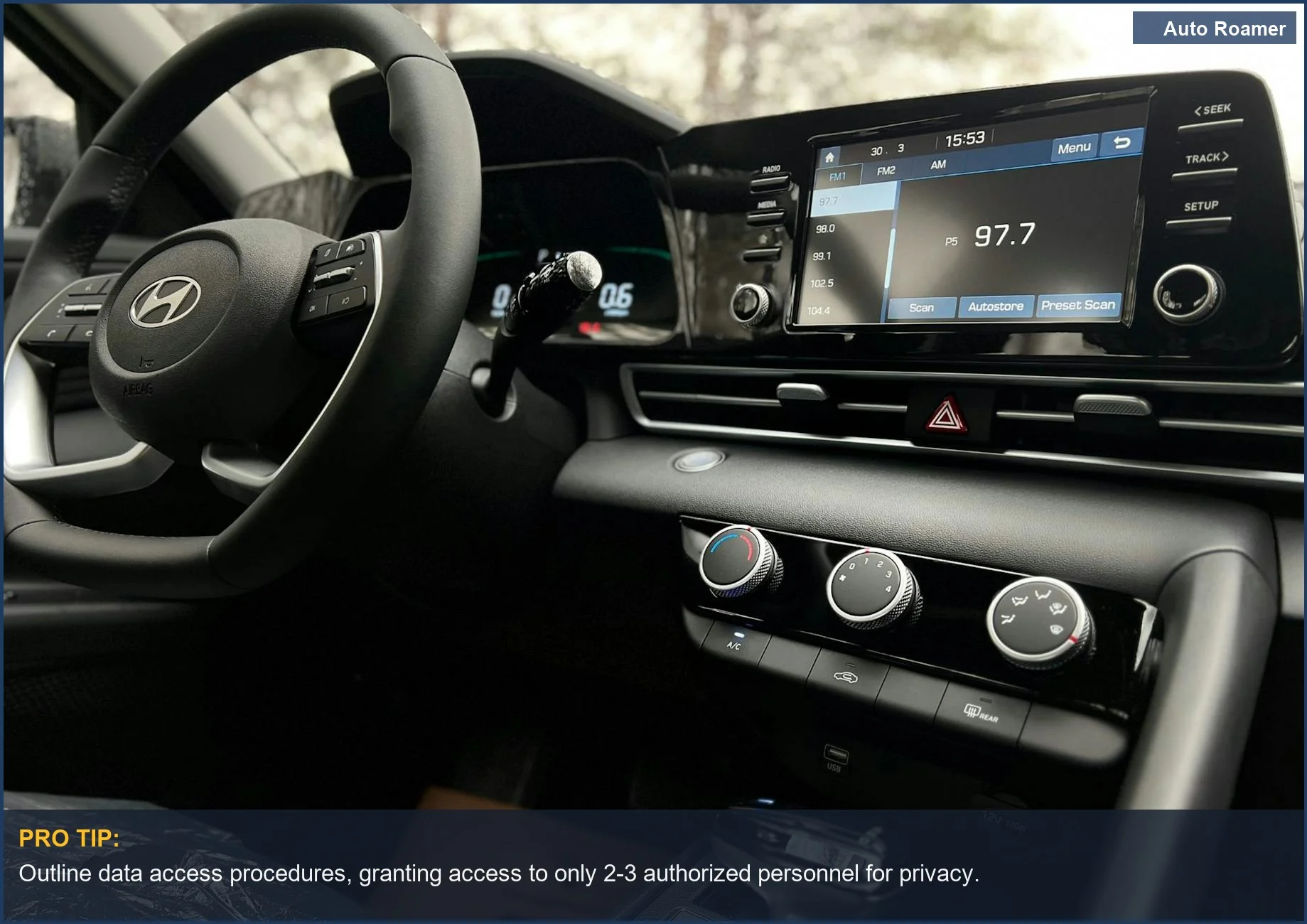
This modern car dashboard with its advanced touchscreen exemplifies the need for a clear company dash cam policy regarding data ownership.
| Photo by Kanat Kairatov
This modern car dashboard with its advanced touchscreen exemplifies the need for a clear company dash cam policy regarding data ownership.
| Photo by Kanat Kairatov
What This Looks Like in Practice
Winter Mountain Pass in a Subaru Outback. We were navigating a blizzard on a steep incline in the Rockies. The road-facing dash cam captured a near-miss with a truck that hydroplaned, while the in-cab camera showed our driver reacting calmly, not panicking. This footage was invaluable for insurance claims and proved our driver was not at fault. The policy clearly stated all data is company property, which prevented any dispute over the video's ownership Dash Camera Policies.
Summer Desert in a Honda Civic. During a heatwave in Arizona, our driver was stopped for a traffic violation. The dash cam footage clearly showed the driver was not speeding but was pulled over for a broken taillight, which had been intermittent. The clear video evidence resolved the situation quickly and prevented an unnecessary citation. This reinforced the benefit of dash cams for protecting drivers from unwarranted stops How to Create a Dash Cam Policy.
Urban Commute in a Delivery Van. Our driver encountered aggressive tailgating in heavy city traffic. The dash cam recorded the incident, including the license plate of the aggressive driver. This data was used to coach the driver on defensive driving techniques and to document the hazardous behavior. The policy outlined driver responsibilities, including reporting system malfunctions, ensuring the dash cam remained operational How to Create a Dash Cam Policy.
Rural Road in a Pickup Truck. While on a remote route, our driver swerved to avoid hitting a deer. The dash cam captured the entire event, including the clear visibility of the animal darting into the road. This footage helped corroborate the driver's account to supervisors and demonstrated adherence to safe driving practices, reinforcing the purpose of the policy to document events and improve safety Dash Cams & Privacy: Employer and Driver Guide for 2025.
While dash cam apps enhance safety, it's worth considering the potential downsides before relying on them completely.
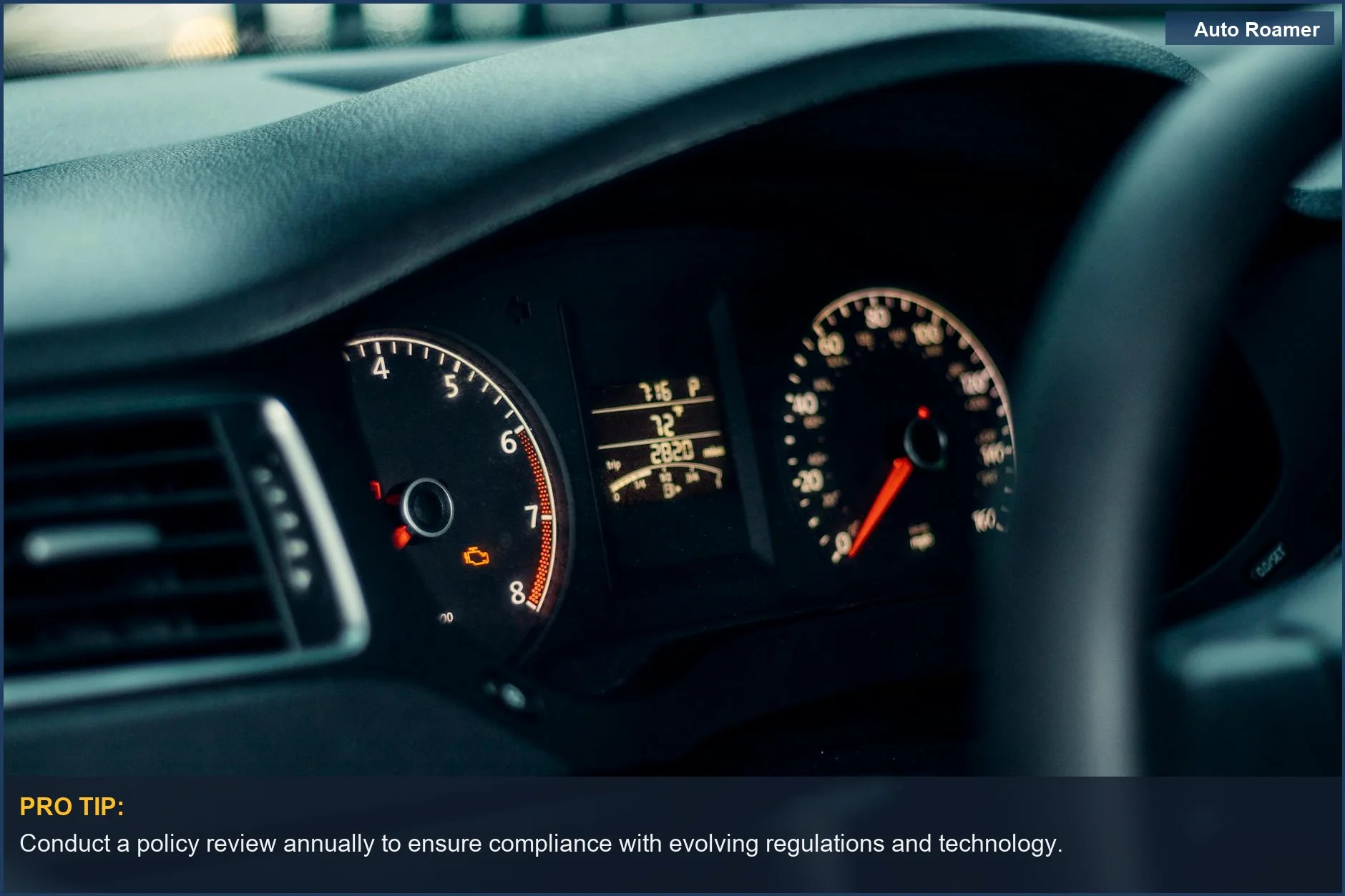
Illuminated gauges on a car dashboard emphasize the critical role of a dash cam usage policy in monitoring fleet operations.
| Photo by Griffin Wooldridge
Illuminated gauges on a car dashboard emphasize the critical role of a dash cam usage policy in monitoring fleet operations.
| Photo by Griffin Wooldridge
Mistakes That Cost People
Symptom Not understanding consent laws for in-cab cameras.
Signal Driver complaints, legal challenges, or fines.
Fix Clearly define in your dash camera policy whether in-cab recording is used. If it is, ensure you comply with one-party consent laws where applicable, and obtain explicit driver acknowledgment, especially in states like California and Florida where two-party consent may be required for audio recordings Dash Cams & Privacy: Employer and Driver Guide for 2025.
Symptom Assuming all dash cam footage is admissible or automatically protects you.
Signal Footage being challenged in court, or not being used effectively in accident investigations.
Fix Understand that data and video are the sole property of the companyDash Camera Policies. Your policy must detail how information will be used for accident investigation and that drivers may not save or share footage without approval.
SymptomOver-reliance on technology without driver accountability.
Signal Persistent unsafe driving behaviors despite dash cam installation.
Fix Implement a policy that mandates drivers participate in coaching sessions based on dash cam data and rewards safe driving How to Create a Dash Cam Policy. Dash cams are a tool, not a complete solution for driver behavior.
SymptomNot updating policies for newer vehicle tech that integrates dash cams.
Signal Older policies don't cover integrated systems, leading to confusion or accidental system disruption.
Fix Older vehicles might have aftermarket dash cams, but newer models often have integrated systems. Your policy must cover drivers not disrupting the normal operation of these systems, including blocking lenses or tampering with power sources, as outlined by Dash Camera Policies.
SymptomVague purpose statements leading to driver distrust.
Signal Driver resistance, anxiety, or increased turnover.
Fix Clearly state the purpose of dash cameras, emphasizing benefits like accident reduction and dispute resolution, not just driver surveillance How to Create a Dash Cam Policy. Transparency builds trust and encourages adoption.
Symptom Assuming a dash cam is always the driver's property.
Signal Disputes over data ownership and footage use.
Fix The policy must explicitly state that all data and video created by the system remains the sole property of the company Dash Camera Policies. This prevents confusion and potential misuse of company assets.
To enhance your driving experience, consider exploring whether there’s a suitable dash cam app for your needs.
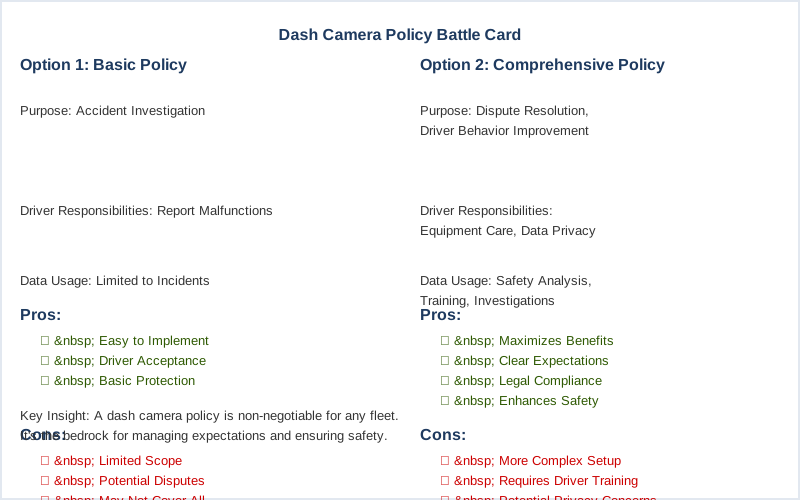
Comparison overview for dash camera policy
Key Takeaways
A clear dash camera policy is non-negotiable for any fleet. It defines driver responsibilities, including reporting malfunctions and prohibiting unauthorized data sharing, while outlining supervisor roles for coaching and accident investigation. This ensures legal compliance and maximizes the safety benefits of dash cams Dash Camera Policies.
Understand privacy implications, especially with in-cab cameras. While road-facing footage is generally accepted for accident resolution, interior recording requires careful consideration of employee rights and state-specific consent lawsDash Cams & Privacy: Employer and Driver Guide for 2025.
Embrace dash cams as a powerful safety tool. They not only provide invaluable evidence for accident investigations but also actively promote safer driving behaviors through real-time alerts and feedback, ultimately protecting both drivers and the company How to Create a Dash Cam Policy.
The single most important takeaway for a robust dash camera policy is transparency and communication. Clearly informing drivers about the purpose, use, and limitations of the dash cam system builds trust and ensures the technology enhances, rather than hinders, fleet operations Navigating Legal Considerations of Dashcams.
To enhance your driving experience, consider following our dash cam instructions for added safety and convenience.
Frequently Asked Questions
What should I know about the rules for using dash cams in my rig?
When you're thinking about using a dash cam, especially in a commercial setting, the first thing to nail down is a clear set of guidelines. This isn't just about the tech; it's about how that data is handled and who sees it. We've found that having a written policy that covers why we're using it, driver responsibilities like reporting malfunctions, and how footage is accessed makes everything smoother. It's about transparency and ensuring everyone knows the score upfront, which can prevent a lot of headaches down the road.
How do dash cams and privacy work together on the road?
Privacy is a big one, and it's not just about what's happening outside the vehicle. While road-facing footage is pretty straightforward for accident reconstruction, in-cab cameras capture more personal moments. We've seen that some states have specific rules about recording conversations, often requiring one-party consent, so it's wise to check your local laws. A good policy clearly defines what's recorded, how long it's stored, and who can access it, which helps balance safety needs with respecting driver privacy.
What's the deal with company policies on dash cam footage?
If you're driving for a company, their dash cam footage is generally considered company property. Policies typically state that drivers can't save, share, or post any video without supervisor approval. This is mainly to protect the company and ensure footage is used correctly for accident investigations or performance reviews. We've learned that understanding these ownership rules is key, so make sure you read and acknowledge any policy provided.
How do companies use dash cam data to help drivers?
Beyond just catching mistakes, dash cam data can actually be a tool for improvement. Companies often use footage to identify risky driving behaviors, like harsh braking or speeding, and then offer coaching to help drivers correct them. Some systems even provide real-time alerts to help drivers adjust their habits on the fly. We've found that when this data is used constructively, it can lead to safer driving for everyone on the road.
What are the main responsibilities for drivers when using dash cams?
As a driver, your main role in a dash cam system is to ensure it's working correctly and not tampered with. This means not shutting it off, blocking the lens, or removing the storage card without permission. You're also expected to report any system malfunctions to your supervisor promptly. Furthermore, you'll likely need to participate in any coaching sessions that arise from the data collected, which is all part of using the technology effectively.