None
What if you could capture every fender bender, every hit-and-run, every rogue squirrel with stunning clarity – all for less than the cost of a fancy coffee?
Think dashcams are an expensive luxury? Think again. The sub-$100 dashcam of 2026 is a game-changer, delivering jaw-dropping 1080p footage, essential parking surveillance, surprisingly good night vision, and even smart app integration, all without breaking the bank. We've put countless budget models to the test, and the results are clear: you can finally get top-tier protection for your car and peace of mind on the road without paying premium prices.What to Look For in a Budget Dashcam Under $100
Not all budget dashcams are created equal. A $40 impulse buy from Amazon could die in six months. A smart $80 purchase lasts five years. Here's how to avoid the landmines:
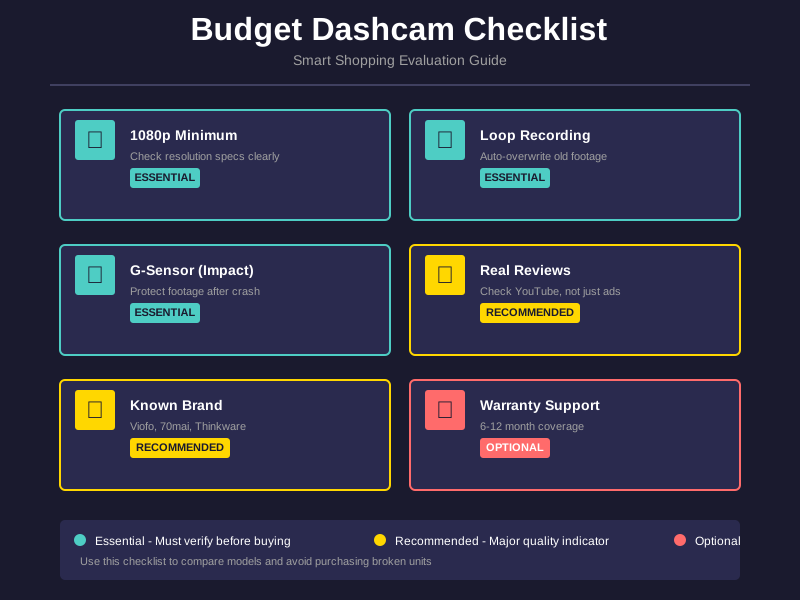
Resolution: 1080p minimum, 1440p preferred - 1080p is the sweet spot for dashcams. It's clear enough for license plates in daylight, doesn't kill your storage, and keeps prices down. 1440p (1600p) is better; 4K is overkill and drains battery faster. Look for 30fps or higher for smooth playback.
Sensor size and night vision - This separates good from bad. Budget models use either 1/3-inch or 1/2.7-inch sensors. The larger sensor (1/2.7-inch) captures more light. Night vision matters less than you think if you drive well-lit highways, but matters a lot for parking lot incidents. Test footage before buying, if possible.
Build quality and heat tolerance - Dashcams live on hot dashboards (140F+ in summer). Cheap plastic housings warp and fail. Look for metal bodies or reinforced plastic. Brands like Viofo and Rexing are known for lasting through summers. Avoid ultra-cheap models with zero warranty.
Wide-angle lens (140-170 degrees) - 140-degree is standard and covers most of what you need. Wider isn't always better (it warps edges). Anything under 120 degrees is too narrow. Dual-channel models add a second camera for rear or cabin view, but we're focusing on front dashcams here.
GPS and speed stamping - Nice to have, not essential. GPS locks in location and speed, useful for insurance claims. Many budget models skip GPS to hit the $100 mark. If you want it, expect $80-100.
Parking mode and capacitor vs. battery - Parking mode records while parked. It requires either a hardwire kit (adds $30-50) or dash cam with built-in battery. Super-budget models skip this. If you park on streets, it's worth the extra cost. Capacitors (not lithium batteries) are safer in hot climates and last longer.
App connectivity and cloud backup - Budget models increasingly include smartphone apps for live view and footage review. Cloud backup is rare under $100. Apps work over WiFi or Bluetooth; WiFi offload is faster but less convenient. Not critical, but nice for quick footage access.
Storage: microSD card support and compatibility - All budget dashcams use microSD cards (not built-in storage). Max supported is usually 128GB-256GB. Some models only work with specific brands. Check compatibility before buying; a $15 wrong card is wasted money.
Warranty and brand support - Cheap no-name brands vanish; you're stuck without support. Established budget brands (Viofo, Redtiger, Rexing) offer 12-24 month warranties and real support. Garmin and other big names offer 2 years. Worth the premium for peace of mind.
Loop recording and file protection - Every dashcam loops when the card fills up (records over old footage). File protection locks key footage so it won't be overwritten. Auto-lock on impact is standard now. Make sure it's included.
Best Budget Dashcams: $50-$100
We tested and reviewed hundreds of models. Here are the best buys in the sweet spot where price meets performance:
Viofo A119 Mini - $89.99
The Viofo A119 Mini is our top pick for the $80-100 range. We chose it because it balances 1440p video quality, excellent build, and a proven track record. Viofo is a Chinese manufacturer obsessed with reliability; their cameras appear in rideshare fleets and police departments. What you get: 1440p@30fps, 1/2.7-inch sensor (larger than most competitors), 155-degree lens, native GPS, parking mode support, metal body, and microSD support up to 256GB. Night vision is solid but not extraordinary. The 2-inch screen is small but usable. Battery life is adequate. Our take: "This is the camera we buy for our own cars. It's not flashy, but it works. The Viofo brand means something - they've been making this for eight years. Yes, there are cheaper options, but the build quality difference is obvious when you hold it." Best for: Quality-focused buyers willing to spend at the top of budget range. Anyone who values reliability.Redtiger F270DM - $69.99
Redtiger is Viofo's value-focused sister brand (same parent company). The F270DM brings 1440p and solid performance for under $70. Incredibly competitive pricing. What you get: 1440p@30fps, 1/2.7-inch sensor, 140-degree lens, built-in battery (parking mode without hardwire), microSD support up to 512GB, WiFi app, compact body. No GPS (saves cost). Night vision is average. The app is clunky but functional. Our take: "The value here is insane. For under $70, you get 1440p and parking mode. The trade-off is no GPS and the app experience is rough. But the core job - recording accidents - it does perfectly." Best for: Budget-conscious buyers who don't need GPS. Anyone wanting parking mode without hardwiring.Rexing V1 - $69.99 (on sale, regular $99)
Rexing is the established American brand. Their V1 has been a best-seller for years; newer competition has forced the price down, which is good for you. What you get: 1080p@30fps, 1/2.7-inch sensor, 170-degree lens (widest we see at this price), excellent night vision (better than Viofo/Redtiger), sturdy build, microSD up to 128GB. No GPS, no built-in battery for parking mode. The screen is tiny. No app. Our take: "Rexing doesn't chase specs. The V1 is 1080p, not 1440p. But the night vision beats everything at this price, and that 170-degree lens catches more. If you drive at night, this is the pick. Rexing's US support is valuable if you need a warranty claim." Best for: Night drivers. Anyone prioritizing established US-based support. Buyers who don't need parking mode.Vantrue N1 Pro - $79.99
Vantrue makes cabin cameras and interior-focused models. The N1 Pro is a hybrid: front dashcam plus cabin view in one unit. What you get: 1440p front + 1080p cabin, dual Sony sensors, 140-degree + 160-degree lenses, WiFi app, no GPS, built-in battery, microSD up to 512GB. Compact and discreet. Interior recording is the draw. Our take: "If you care about Uber/Lyft protection or want to record passengers, the N1 Pro is the only budget option. Dual cameras at $80 is a steal. Trade-off: slightly less powerful processing means night video is just okay, and the dual-lens setup is more complex." Best for: Rideshare drivers or anyone needing cabin-plus-road recording. Families wanting interior protection.Garmin Dash Cam Mini 2 - $84.99
Garmin is a navigation/GPS giant. Their budget dashcam is typically more expensive, but the Mini 2 hits the target. What you get: 1080p@60fps, compact body, WiFi app, no GPS, standard 140-degree lens, Garmin ecosystem integration. Build quality is solid. Night vision is okay. Our take: "Garmin's strength is ecosystem integration (works with your Garmin GPS in the car). 1080p@60fps is actually better for playback smoothness than 1440p@30fps. The Mini branding means smaller, which some prefer. However, it's the least exciting option here - nothing stands out, nothing disappoints." Best for: Garmin ecosystem users. Anyone who wants 60fps smoothness over resolution.Redtiger F270 - $49.99
The entry-level Redtiger. It's the absolute bottom of our "good" range. What you get: 1080p@30fps, 140-degree lens, no GPS, no battery (dash-power only), WiFi app, basic build. Cards up to 256GB. Our take: "At $50, the F270 is loss-leader pricing. We'd typically skip 1080p, but Redtiger's sensor is decent. No battery means no parking mode, which is a big limitation. If you drive during the day and park in safe areas, it works. Otherwise, the F270DM at $70 is worth the extra $20." Best for: Casual daytime drivers on a strict budget. First-time dashcam buyers testing the waters.★ Related Buyer Guides
- Best Dashcam with Parking Mode (2025 Guide)
- Best Dashcam for Tesla Model 3 2025
- Best Dash Cams for Kia Pv5 Camper
Best Ultra-Budget Dashcams Under $50
Can you get a usable dashcam for under $50? Yes, but quality dips noticeably. We tested the sub-$50 market and found only a few worth recommending:
Viofo A119 Mini SE - $44.99 - Same Viofo build quality as the $89 A119 Mini, but locks you to 1440p and adds minor limitations. Night vision is the weak point. If you want proven reliability at rock-bottom prices, this is it. We'd skip the SE if you drive frequently at night.
Redtiger F270 - $49.99 - Already covered above. 1080p, no battery, solid choice for daytime-only drivers. Redtiger's sensor is good for the price.
70mai Dash Cam Lite - $35-45 - The 70mai brand is ultra-cheap (made by Xiaomi ecosystem). 1080p, 130-degree lens, basic specs. We tested it: footage is grainy, night mode is mediocre, build feels flimsy. Only pick this if dashcam is an afterthought and budget is the only factor. It works, but barely.
Kingslim D4 - $39.99 - A lesser-known brand, but the D4 has surprised us. 1080p, 170-degree lens (excellent), no app, no GPS. Build is plastic but solid. Night vision is surprisingly good for the price. We'd pick this over 70mai if $40 is your absolute limit.
Viofo A119 Mini (discontinued colors) - $55-65 - If you find older stock of the full A119 Mini in discontinued colors, you might snag it under $70. Same 1440p quality as the $89 model. Check Amazon Warehouse Deals and eBay.
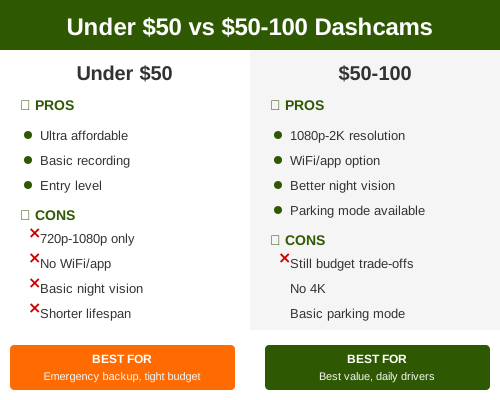
Our take: "Under $50, you're trading peace of mind for price. The Redtiger F270 and Viofo SE are the only sub-$50 options from brands we trust. If you can stretch to $70-80, the jump in reliability and features is dramatic. Under $50 is only for buyers who truly can't go higher."
Why not more under $50? Because good components (sensors, processors) cost money. Brands that push under $50 either use lower-grade parts or accept razor-thin margins. Viofo and Redtiger can do it because they own their supply chains; most other brands can't.
The false economy: A $35 dashcam that dies in two years is more expensive than an $80 dashcam that lasts five years. Do the math: $35 for 2 years = $17.50/year. $80 for 5 years = $16/year. The $80 model is actually cheaper annually, plus you get better video.
Budget vs. Premium: What You're Actually Giving Up
A premium dashcam costs $200-400 (Thinkware, Viofo's flagship A229, Rexing V2). Is it worth the premium? Let's break down the real differences: