
How Far Should You Stay Behind a Semi Truck on the Highway?
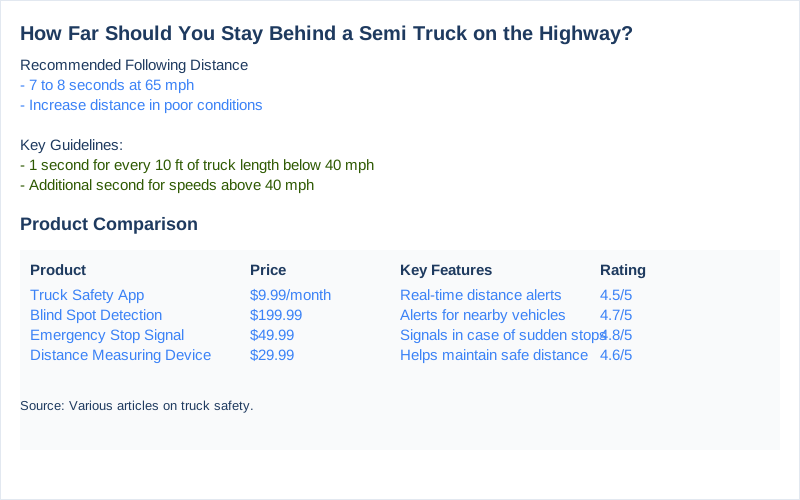
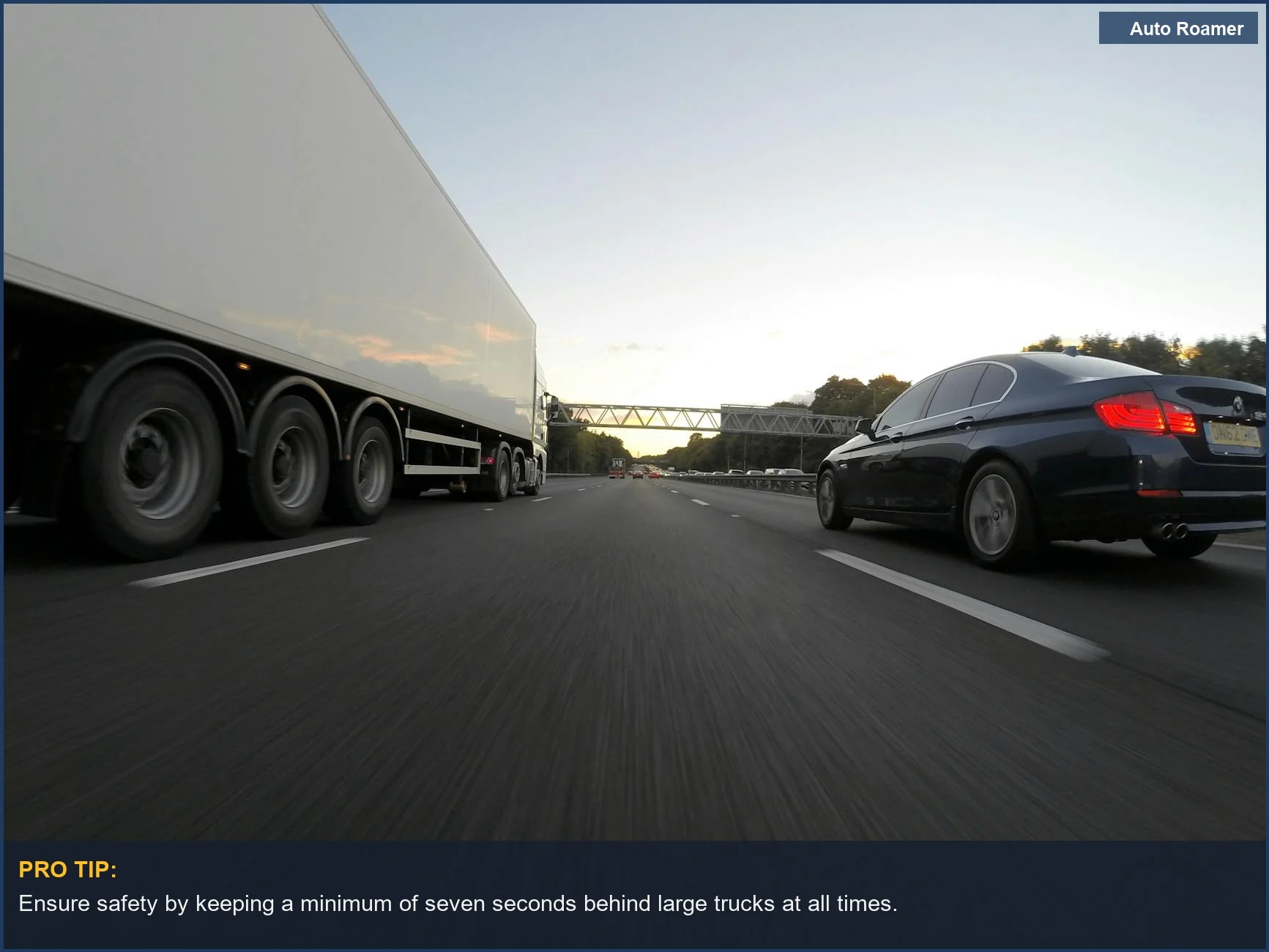
To ensure safety on the highway, maintain a following distance of at least seven to eight seconds behind a semi truck. This distance is essential due to the truck's significant weight, which can increase stopping distances. Additionally, remember that semi trucks have larger blind spots, making adequate space crucial for visibility and reaction time.
Introduction
When driving on the highway, the size and weight of semi trucks present unique challenges for both truck drivers and those in passenger vehicles. Understanding how far we should stay behind a semi truck is crucial for maintaining safety on our roads. The recommended following distance behind a semi truck can vary based on several factors, including speed, road conditions, and the truck's weight. It's essential to recognize that semi trucks require a longer stopping distance than standard vehicles due to their size and mass. For instance, at speeds of 65 mph, a heavy truck can cover nearly 100 feet every second, making a mere second of following distance potentially dangerous in the event of sudden braking Source.
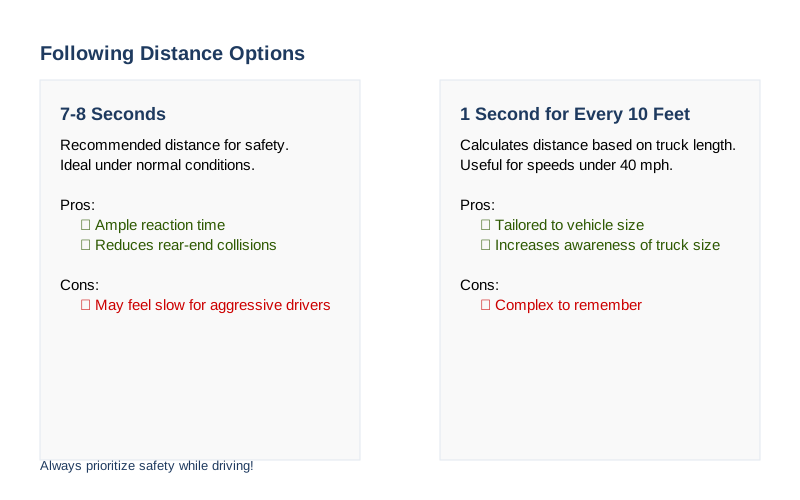
To ensure safety, we recommend maintaining a following distance of at least seven to eight seconds when driving behind a semi truck. This distance allows ample time to react if the truck stops unexpectedly Source. In conditions that are less than ideal, such as rain or snow, it would be prudent to increase that distance even further. The Federal Motor Carrier Safety Administration advises that drivers should leave one second of following distance for every 10 feet of vehicle length when traveling under 40 mph, and at least one additional second for speeds above that Source.
Furthermore, a good rule of thumb is that if you cannot see the mirrors of the semi truck ahead, you are likely too close. By adhering to these guidelines, we can enhance our safety and that of others on the road while reducing the risk of rear-end collisions, which are among the most preventable types of accidents in commercial trucking Source.
Quick Answer
To ensure safety while driving behind a semi truck on the highway, we recommend maintaining a following distance of at least seven to eight seconds. This distance is crucial due to the significant weight and size of semi trucks, which means they require a longer stopping distance compared to standard vehicles. At highway speeds, maintaining this distance gives us ample time to react if the truck ahead suddenly brakes. For instance, if we are traveling at 65 miles per hour, a semi truck can cover about 100 feet every second. Thus, being just one second too close can be detrimental, as we may not have enough time to stop safely if the truck in front of us stops abruptly Source.
In practical terms, we can measure our following distance by counting seconds. Start counting when the rear of the truck passes a stationary object, such as a sign or a tree, and stop when we reach that same object. This method helps us visually gauge the distance and ensure we are not tailgating. Additionally, it's advisable to increase this distance in adverse weather conditions, such as rain or fog, where stopping distances can increase significantly Source.
Moreover, if we cannot see the truck's side mirrors, it's a clear sign that we are too close; ideally, we should be able to see the mirrors at all times Source. Adhering to these guidelines will enhance our safety and the safety of others on the road, reducing the risk of rear-end collisions significantly.
What You Need to Know
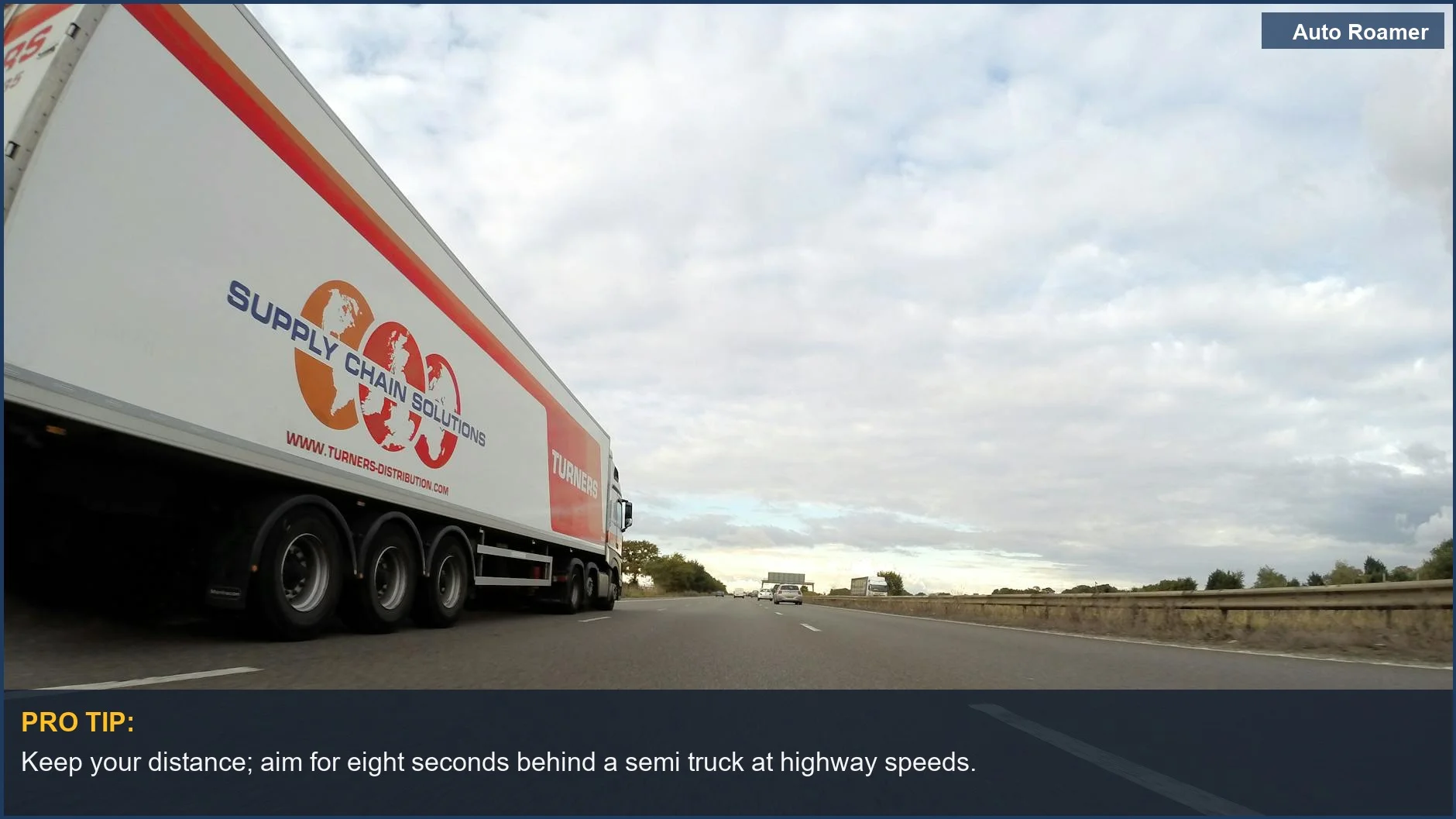
To ensure safety on the highway, it is crucial to maintain an adequate following distance behind a semi truck. The recommended following distance is generally between seven to eight seconds when traveling at highway speeds. This distance allows for the necessary reaction time should the truck need to stop suddenly. A semi truck, especially when fully loaded, can take significantly longer to come to a halt compared to a passenger vehicle. At 65 mph, for instance, a truck can cover nearly 100 feet every second, making a mere one-second lapse in following distance potentially disastrous (Source).
When calculating our following distance behind a semi truck, we recommend using the "three-second rule" as a baseline for smaller vehicles and adapting it for larger trucks. If you're traveling under 40 mph, the Federal Motor Carrier Safety Administration advises a following distance of one second for every ten feet of your vehicle's length. For example, if you are driving a vehicle that is 20 feet long, you should maintain a distance of at least two seconds from the truck ahead of you (Source).
Moreover, it is also beneficial to ensure that you can see the truck's mirrors; if you cannot, then we are likely following too closely. Maintaining this safe following distance not only keeps us safe but also helps to prevent rear-end collisions, which remain one of the most common types of accidents involving commercial vehicles (Source). Always remember, the more space we leave, the more time we have to react in case of an emergency.
Step-by-Step Guide
When it comes to maintaining a safe following distance behind a semi truck on the highway, we recommend a methodical approach to ensure safety for all road users.
-
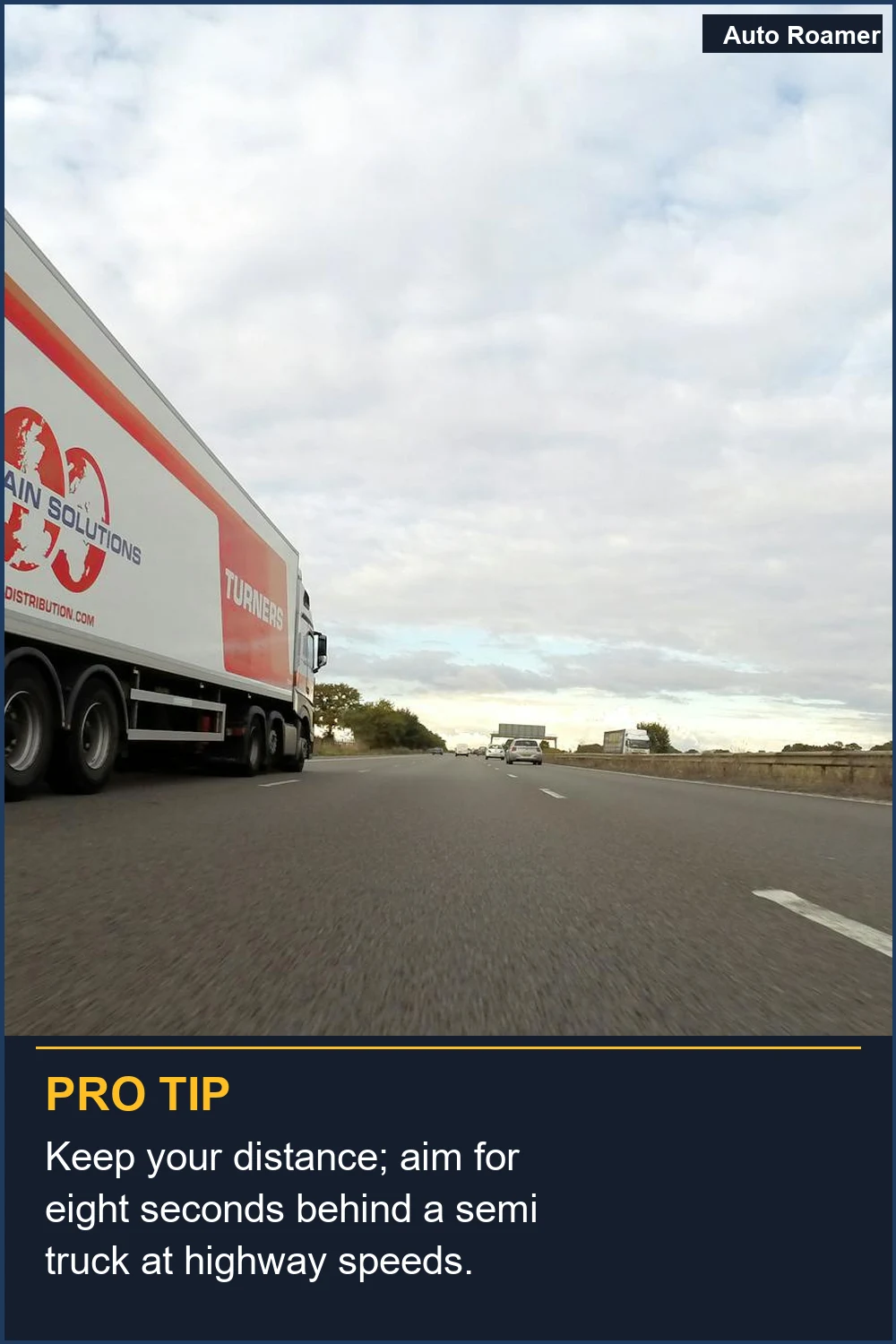
Determine Your Speed: First, assess your speed. If you're traveling at 65 mph, we should aim for a following distance of at least six seconds behind a semi truck. This equates to roughly 528 feet, giving us ample time to react should the truck brake suddenly. At slower speeds, such as under 40 mph, we should allow one second of following distance for every ten feet of our vehicle's length to maintain safety Source.
-
Use the "Three-Second Rule": To gauge our following distance, we can use the "three-second rule." This involves picking a marker on the side of the road, such as a sign or a tree. When the semi truck passes it, we should start counting: "one thousand one, one thousand two, one thousand three." If we reach the marker before finishing the count, we are too close and need to increase our distance Source.
-
Adjust for Conditions: Weather and road conditions play a significant role in determining our following distance. In adverse weather, such as rain or snow, we should double our following distance to account for reduced traction and longer stopping distances. In these conditions, allowing eight to ten seconds can be prudent Source.
-
Visibility Check: Another practical step is to ensure we can see the truck's side mirrors. If we can't see them, we are likely too close. This visibility check helps us maintain an appropriate following distance behind the semi truck Source.
By implementing these steps, we can safely navigate the highway while maintaining a proper following distance behind semi trucks, ultimately contributing to safer roads for everyone.

Safety Considerations
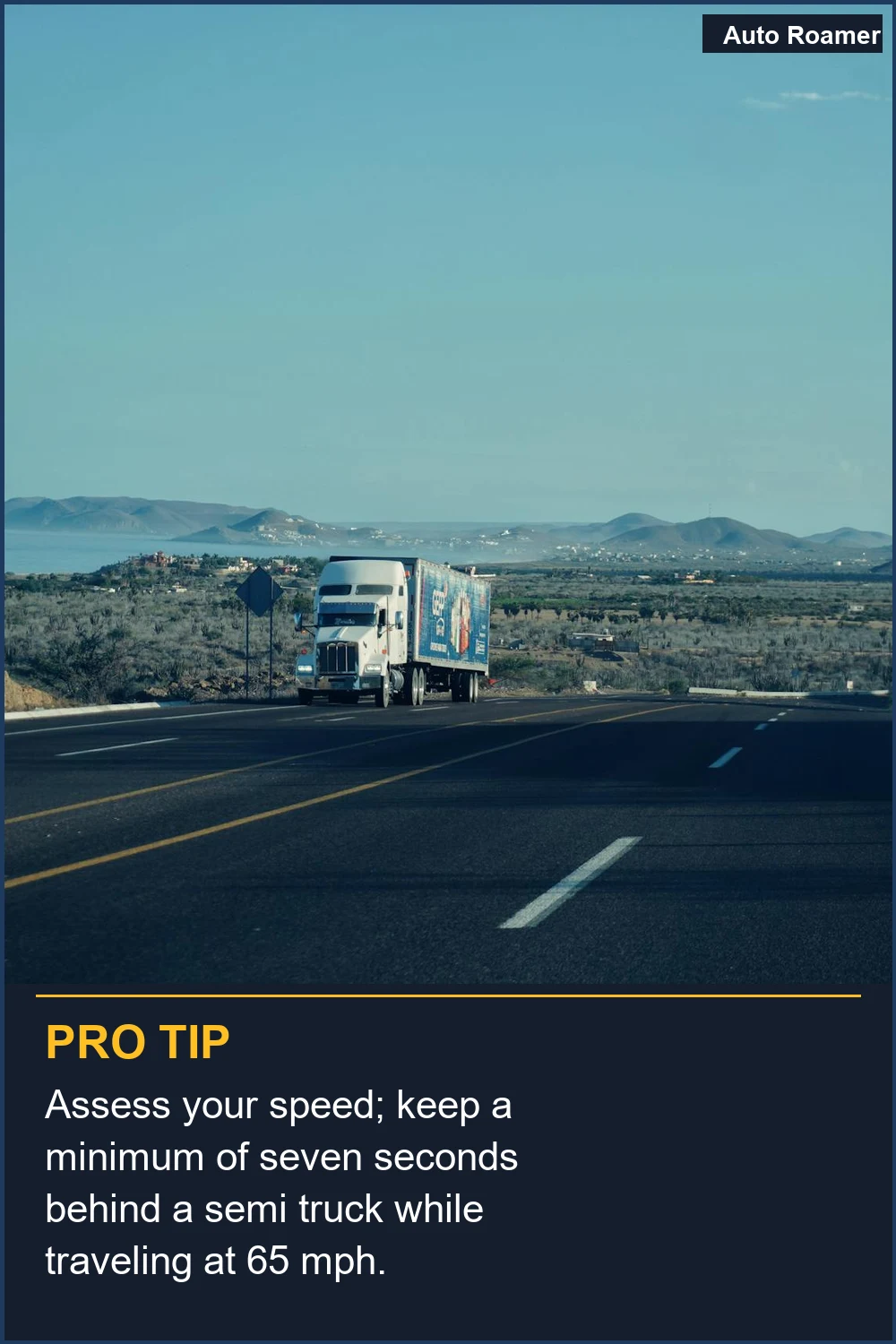
Maintaining a safe following distance behind a semi truck on the highway is crucial for our safety and the safety of other road users. The size and weight of semi trucks mean they require significantly more time and distance to come to a complete stop compared to standard vehicles. We recommend a following distance of at least seven to eight seconds in ideal driving conditions. This distance allows us enough time to react if the truck in front of us suddenly brakes or encounters an unexpected obstacle. At a speed of 65 mph, this translates to roughly 400 feet of space, a considerable distance that can help prevent rear-end collisions, which are common in heavy traffic situations Source.
Under adverse weather conditions, such as rain or fog, we should increase our following distance even further. It is essential to account for road conditions and visibility, as they can significantly impact stopping distances. For instance, in wet conditions, it may take a semi truck up to 400% longer to stop compared to dry conditions Source. Additionally, if we cannot see the truck's side mirrors, we are likely too close, and we should back off to ensure we have an adequate buffer zone Source.
Understanding how to calculate and maintain an appropriate following distance behind a semi truck is not just about adhering to safety guidelines; it is about being proactive in preventing accidents. By giving ourselves ample space, we can ensure a smoother driving experience and contribute to a safer roadway for everyone.
Common Mistakes to Avoid
When it comes to maintaining a safe following distance behind a semi-truck, there are several common mistakes that drivers often make. One of the most prevalent errors is not allowing enough space. Many drivers underestimate how long it can take a heavy truck to come to a complete stop. At highway speeds, a semi-truck can cover nearly 100 feet every second, meaning that a mere second of tailgating can lead to catastrophic results. We recommend maintaining a following distance of at least seven to eight seconds, especially in ideal conditions, as outlined by the Schneider Jobs blog.
Another frequent mistake is failing to adjust the following distance based on road conditions. Drivers sometimes forget that wet, icy, or gravel roads can significantly increase stopping distances. In such cases, we should consider increasing our following distance to ensure we have ample time to react if the truck in front of us suddenly brakes. As emphasized in the Lytx blog, environmental factors play a crucial role in determining how closely we can safely follow another vehicle.
Lastly, many drivers do not pay attention to the visibility of the truck's mirrors. If we cannot see the truck's mirrors, we are likely too close, which poses a serious risk. To avoid these common pitfalls, we should always strive to maintain a safe following distance behind semi-trucks, taking into consideration speed, road conditions, and our own visibility. Remember, a safe distance not only protects us but also contributes to overall road safety.
Final Thoughts
When it comes to maintaining a safe following distance behind a semi truck on the highway, the stakes are incredibly high. The sheer size and weight of these vehicles mean they require significantly more time and space to stop compared to standard cars. We recommend adhering to a minimum following distance of seven to eight seconds when driving behind a semi truck. This guideline is essential, especially at highway speeds where a heavy truck can cover nearly 100 feet every second. A mere second too close can drastically change the dynamics of a potential accident, resulting in severe consequences.
To calculate this distance accurately, we can use a simple method: when the truck passes a fixed object, such as a sign or a tree, start counting seconds until you reach the same point. This method helps us gauge whether we are maintaining an adequate following distance, ensuring we can react swiftly in case the truck suddenly brakes or changes lanes. According to best practices for commercial vehicles, the recommended distance increases with speed and adverse weather conditions, underscoring the importance of consistently adjusting our distance based on driving conditions.
Additionally, visibility plays a crucial role in maintaining a safe following distance. If we cannot see the truck's side mirrors, it is likely that we are too close. This simple rule can help prevent dangerous situations and ensure that we are always prepared for unexpected stops. In conclusion, maintaining a proper following distance behind a semi truck is not just a matter of convenience; it's a matter of safety. By adhering to these guidelines, we can significantly reduce the risk of rear-end collisions and contribute to a safer highway environment for everyone. For more information on this topic, consider checking out this guide on following distances.