None
Introduction: The Ford Ranger as Your Perfect Truck Camping Platform
The modern Ford Ranger (2019-present generation) represents a sweet spot for truck campers. It's not so massive that it's difficult to maneuver on backroads and into tight camping spots, yet it offers genuine truck capability with a usable bed for sleeping. Unlike the full-size F-150, the Ranger's mid-size profile makes it easier to park in standard parking spaces while still providing nearly 5 feet of protected cargo space. What makes the Ranger compelling for car camping is the combination of practicality and capability. The compact footprint doesn't sacrifice interior comfort—you get a 5-foot-3-inch bed (SuperCrew) or up to 6-foot bed (SuperCab) with easy access, a relatively modern interior with useful tech features, and impressive off-road capability on available trim levels. The EcoBoost engine options provide reasonable fuel economy for a truck, important for extended camping trips. Ford's Ranger specifically targets outdoor enthusiasts with Tremor and Raptor trim levels that add off-road features perfect for accessing remote camping locations. The mid-size platform means less fuel cost than F-150 camping while maintaining truck bed practicality that trucks inherently offer over SUVs. This guide covers everything you need for truck bed camping in a Ford Ranger: bed dimensions, mattress options, setup procedures, storage organization, and tips for maximizing your Ranger's camping capability.What You'll Learn
What You'll Learn
Ford Ranger Bed Dimensions and Sleeping Space
Understanding your Ranger's bed dimensions is crucial for choosing the right mattress and planning your sleeping setup.
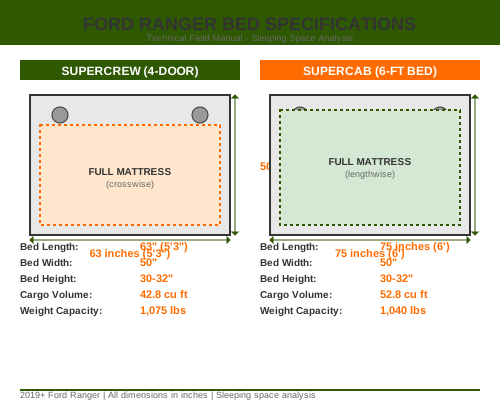
Bed length (interior): 63 inches (5 feet 3 inches)
Bed width (interior): 50 inches (between wheel wells)
Bed height (ground to top of rail): 30-32 inches
Bed depth: 20-22 inches (from wheel well to side)
Cargo volume: Approximately 42.8 cubic feet
Weight capacity: 1,075 lbs (payload varies by configuration)
6-foot bed length (interior): 75 inches
Bed width (interior): 50 inches (same as SuperCrew)
Bed height: 30-32 inches (same)
Bed depth: 20-22 inches
Cargo volume: Approximately 52.8 cubic feet
Weight capacity: 1,040 lbs (slightly less due to longer bed)
Couples sleeping crosswise (perpendicular to truck length)
Single campers with room for gear alongside
Urban parking situations where shorter trucks are advantageous
Four-door configuration preferred by many
SuperCab (6') is ideal for:
Couples sleeping lengthwise (head-to-toe along truck length)
Solo campers who want maximum comfort space
Those needing maximum cargo volume for gear
Solo or couple camping focused campers
Twin mattresses: Yes, fits with tight quarters
Full mattress: Yes, perfect sleeping width for couples
Queen mattress: No, exceeds bed width
Crosswise sleeping (SuperCrew): Fits a full or queen-size perpendicular to truck length
Most Ranger campers choose either a full-size lengthwise or position themselves crosswise in the longer SuperCab for maximum comfort.
Protective liner: Consider plastic or rubber bed liner to protect mattress from rough bed surface
Existing liners: Most modern Rangers have factory bed liners (plastic spray or rubber drop-in)
Rough spots: Sand any rough metal or nail stubs
Drain holes: Ensure bed drains properly after rain
Bed floor condition: Ranger beds are in excellent condition from factory
SuperCrew Bed Dimensions
The SuperCrew (4-door) model comes with a 5-foot-3-inch bed:SuperCab Bed Dimensions
The SuperCab (2-door or extended cab) offers longer bed options:Bed Configuration Considerations
SuperCrew (5'3") is ideal for:Width and Sleeping Options
The 50-inch width between wheel wells accommodates:Bed Box Condition and Protection
Before camping, check:Key Specifications for Camping
| Feature | Value | Benefit for Camping | |---|---|---| | Cargo/bed space | See specs section | Determines gear capacity | | Sleeping surface | 5-8 feet | Comfortable sleeping | | Headroom | 18-36 inches | Ventilation, movement | | Power outlet | 12V/USB | Device charging | | Climate control | Available | Temperature management | | Towing capacity | Varies | Trailer camping options | | Ground clearance | 8-11 inches | Remote campsite access |Best Mattress Options for Ford Ranger Sleeping
The Ranger's bed accommodates various mattress types depending on your sleeping configuration and camping style.
AirBedz PPI-103SL: Full-size truck-specific, 9.5-inch height
Intex Dura-Beam Standard: Budget-friendly, 10-inch height
Coleman Airbed Queen: Larger option that requires crosswise positioning
Advantages:
Adjustable firmness via air pressure control
Easy storage when deflated
Comfortable sleeping surface
Quick setup and breakdown
Disadvantages:
Requires air pump (manual or electric)
Potential puncture risk on rough bed surfaces
Requires maintenance (checking air levels)
Can feel less supportive in colder temperatures
Best for: Campers who prioritize ease of setup and storage
Single 4-6 inch foam pad (lightweight option)
Twin foam pads placed side-by-side for couples
Full-size folding foam mattress (tri-fold design)
Recommended models:
Milliard Full Tri-Fold Mattress: Hotel-quality, portable
LUCID 6-Inch Folding Mattress: Full-size, excellent reviews
Zinus Trifold Queen: Slightly oversized but compressible
Advantages:
Consistent, hotel-quality comfort
No inflation or air pressure management
Provides insulation from cold bed
Durable construction
Disadvantages:
Bulky to store when not in use
Heavier than air mattresses
Takes truck bed real estate
Requires secure tie-down to prevent shifting
Best for: Campers prioritizing comfort and already have vehicle space
Single large pad (2-3 inches) for singles
Dual pads for couples
Premium pad with sleeping bag system
Recommended models:
Exped SynMat HL: Ultralight, excellent insulation
Therm-a-Rest MondoKing: Large, comfortable, self-inflating
Cascade Designs ProLite: Budget-friendly, adequate comfort
Advantages:
Partially self-inflate (reduce pumping effort)
Better insulation than air mattresses
Packable when deflated
Excellent for temperature control
Disadvantages:
More expensive than basic air mattresses
Still requires some hand inflation
Less sleeping surface than full mattresses
Thinner comfort layer than foam
Best for: Backpacker-style campers or those with limited truck bed space
2x6 or 2x8 lumber cut to bed dimensions
Plywood deck on top
Creates storage underneath
Add 3-4 inch foam on top
Advantages:
Customizable to your bed dimensions
Creates under-bed storage
Platform height raises you above cold
Combines comfort with organization
Disadvantages:
Requires construction skills
Takes vehicle bed space permanently
Heavy and difficult to remove
Reduces payload capacity
Best for: Permanent or semi-permanent Ranger conversion campers
Full-Size Air Mattresses
Air mattresses offer flexibility and easy deflation for daytime use: Optimal dimensions: Full-size (54" x 75") fits lengthwise in SuperCab or Ranger truck Recommended models:Foam Mattresses
Foam mattresses provide hotel-like comfort without inflation needs: Optimal configurations:Self-Inflating Camping Pads
Self-inflating pads balance comfort and packability: Optimal configurations:DIY Platform Sleeping Systems
Many Ranger campers build custom sleeping platforms: Basic platform construction:Setting Up Your Ranger for Truck Bed Sleeping
Proper Ranger truck bed setup ensures safe, comfortable, and organized sleeping and camping.
Position full-size mattress crosswise (perpendicular to truck length)
Center it so equal space on both sides
Leave 6-12 inches for gear at the cab end
Ensure even weight distribution
For SuperCab (6' bed):
Position full-size mattress lengthwise (parallel to truck length)
Position head near cab or toward tailgate based on preference
Leave gear space at the foot end
Consider slightly perpendicular positioning for maximum comfort width
Next to tailgate or cab (outside sleeping area)
Or place under mattress if platform setup
Away from direct sun on driver's side
Gear bags:
Backpacks in floor between truck bed and cab wall
Duffels at tailgate or on roof rack
Soft items that can't puncture mattress okay alongside
Frequently needed items:
Headlamp on truck bed rail within reach
Phone charger in cup holder or on rail
Water bottle on bed rail near head
Bathroom supplies in small bag accessible from bed
Valuables:
Keep in cab with doors locked
Or secured in tool box
Never visible through windows
Step 1: Clear and Prepare the Bed
Start with a clean bed: 1. Remove unnecessary items: Clear all work tools, cargo, or debris 2. Clean thoroughly: Sweep out dirt, leaves, or particles 3. Inspect for hazards: Look for sharp edges, exposed metal, or fasteners 4. Check the bed liner: Verify plastic or rubber liner is intact and secure 5. Add protection layer: Place cardboard or cheap tarp over liner for mattress protectionStep 2: Position Your Mattress
Align mattress carefully: For SuperCrew (5'3" bed):Step 3: Secure Your Mattress
Prevent mattress movement while sleeping: 1. Use ratchet straps: Secure mattress to bed rails if possible 2. Apply painter's tape: Prevents mattress sliding on plastic liner 3. Weight with gear: Pack coolers and gear alongside mattress 4. Avoid overly tight straps: You want security, not compressionStep 4: Set Up for Sleep
Create a comfortable sleeping environment: 1. Add fitted sheets: Helps mattress stay secure and protects it 2. Layer blankets strategically: Sleeping bag or top blankets for warmth 3. Position pillows: Optimal neck support for sleeping position 4. Test firmness: Adjust air pressure if using air mattress 5. Verify levelness: Sleeping on a slight slope? Move gear to rebalanceStep 5: Organize Gear Strategically
Maximize bed space while keeping necessities accessible: Cooler placement:Step 6: Ventilation and Weather Protection
Manage air flow and weather: 1. Crack windows: 1-2 inches on opposite sides for air flow 2. Use tonneau cover or canopy: If available, covers provide weather protection and privacy 3. Consider bed tent: Attaches to tonneau cover or truck bed rails 4. Bug screens: Prevent insects if windows open 5. Monitor weather: Have backup plan if storms threatenStep 7: Nighttime Safety Setup
Prepare for sleeping safely: 1. Interior lights: Ensure dome light turns off automatically 2. Door locks: Lock doors while sleeping 3. Windows: Lock or secure from inside 4. Headlamp: Keep accessible for nighttime bathroom trips 5. Emergency supplies: First aid kit accessible but secure 6. Communication: Ensure phone has service or satellite messenger 7. Exit strategy: Ensure you can exit quickly if neededRanger Off-Road Trim Options for Remote Camping Access
Ford's Ranger Tremor and Raptor packages specifically support off-road camping adventures.
All-terrain tires: BFGoodrich or similar all-terrain compound
Increased ground clearance: 0.6 inches higher than standard
Skid plates: Protect transmission and fuel tank
Terrain management modes: Snow/Slippery, Sand, Rock, and Mud settings
Unique styling: Distinctive grille and trim cues
Integrated roof rails: Better for gear loading
Off-road suspension tuning: Optimized for trail capability
Tremor capability:
Forest service roads and fire roads
Moderate rocky terrain
Beach and sand access
Graded dirt roads
Light trail access to dispersed camping
Rock garden negotiation (moderate)
Not suitable for:
Extreme rock crawling
Deep water crossings
Tight narrow trails
Steep hillside traversal
High-performance suspension: Fox shock absorbers (2.3-inch internal bypass)
Increased ground clearance: 1+ inch higher than Tremor
Reinforced frame: Heavy-duty undercarriage
All-terrain tires: BFGoodrich KO2 on 17-inch wheels
Multiple skid plates: Comprehensive undercarriage protection
Terrain management: Advanced drive modes
Trail camera integration: Rear under-vehicle view
Rock sliders: Protect sides on rocky terrain
Unique exterior: Aggressive stance and styling
Raptor capability:
Everything Tremor handles
Rock crawling and technical terrain
Steep hill climbing
Deep sand and mud
Tight trail navigation
Stream crossings
Remote backcountry access
4WD system with electronic locking rear differential (available)
Adequate ground clearance (8.6 inches)
All-terrain tire options
Integrated terrain management systems
Handles typical camping road access
Best for: 80% of truck camping scenarios without premium trim cost
Ranger Tremor Package
The Tremor adds accessible off-road capability: Tremor-specific features:Ranger Raptor Package
The Raptor provides maximum off-road capability: Raptor-specific features:Standard Ranger Off-Road Ability
Even non-Tremor/Raptor Rangers offer capability: Available on standard models:Which to Choose?
Standard Ranger: Best value for casual camping, most capable truck size for maneuvering Tremor: Sweet spot for outdoor enthusiasts with 80% of Raptor capability at lower cost Raptor: Maximum capability for serious off-road camping and extreme terrain explorationFord Ranger vs. Other Mid-Size Trucks for Camping
How does the Ranger compare to competing mid-size trucks for car camping?
Bed length: Ranger (5'3" SuperCrew, 6' SuperCab) vs Colorado (5' standard, 6' available)
Bed width: Both 50 inches
Interior refinement: Ranger edges Colorado in modern tech
Off-road packages: Colorado ZR2 similar to Ranger Raptor
Fuel economy: Comparable (20-23 MPG)
Towing capacity: Ranger up to 7,500 lbs, Colorado up to 7,700 lbs
Reliability: Both strong track records
Cabin size: Similar, Colorado slightly more spacious
Choose Ranger for: Ford dealer network, modern interior, Raptor off-road option
Choose Colorado for: ZR2 off-road capability, slightly larger cabin
Bed length: Tacoma (5', 5'8") vs Ranger (5'3", 6')
Bed width: Tacoma 50.8" vs Ranger 50"
Off-road reputation: Tacoma legendary, Ranger catching up
Reliability: Tacoma slightly stronger reputation
Comfort: Ranger more modern, Tacoma more rugged feeling
Towing: Ranger (7,500 lbs) vs Tacoma (6,800 lbs)
Price: Similar, slight variations by model year
Choose Ranger for: Better fuel economy, modern tech, value
Choose Tacoma for: Off-road legend status, proven durability
Bed dimensions: Similar to Colorado (Ranger competitive)
Cabin luxury: Canyon slightly more upscale
Off-road options: Less developed than Ranger/Colorado
Towing capacity: 7,700 lbs (similar to Ranger)
Fuel economy: Comparable
Reliability: Proven but fewer enthusiasts
Choose Ranger for: Off-road packages, Ford reliability network
Choose Canyon for: Luxury interior appointments, GMC brand preference
Bed length: Frontier (5'6") vs Ranger (5'3"/6')
Cabin style: Frontier more industrial, Ranger more refined
Off-road capability: Ranger Raptor superior
Towing: Ranger (7,500) vs Frontier (6,720)
Technology: Ranger more advanced
Price: Frontier often less expensive
Choose Ranger for: Off-road capability, modern tech, towing
Choose Frontier for: Price point, no-nonsense truck
Better maneuverability: Easier tight camping spot access
Lower fuel costs: Better economy than F-150
Easier urban parking: Shorter wheelbase, narrower profile
Lower payload penalty: Less weight when lightly loaded
Camping sweet spot: Most truck, minimal compromise
The Ranger's specific advantage is the variety of bed lengths (5'3" vs 6') and the well-developed Tremor/Raptor off-road packages.
Ranger vs. Chevrolet Colorado
Direct mid-size competitor:Ranger vs. Toyota Tacoma
Popular Toyota alternative:Ranger vs. GMC Canyon
GM's mid-size alternative to Colorado:Ranger vs. Nissan Frontier
Nissan's truck offering:Mid-Size Truck Camping Advantage
All mid-size trucks share advantages over full-size F-150:Frequently Asked Questions
Can you sleep in a Ford Ranger truck bed?
Yes, the Ranger is designed for truck bed sleeping. With SuperCrew (5'3") you can sleep crosswise with a full mattress. SuperCab (6') allows lengthwise sleeping with full or small queen mattress. The truck bed provides secure, enclosed sleeping space.
What size mattress fits a Ford Ranger?
A full-size mattress (54" x 75") is ideal for Ranger truck beds. SuperCrew sleeps crosswise; SuperCab sleeps lengthwise. Twin mattresses work side-by-side in SuperCab but are cramped. Queen-size exceeds 50-inch bed width and doesn't fit.
SuperCrew vs. SuperCab for camping?
SuperCrew (5'3", 4-door) is more maneuverable and easier to park. SuperCab (6', 2-door) offers longer bed for lengthwise sleeping. For urban camping, SuperCrew wins. For pure comfort, SuperCab is superior.
Is the Ranger Tremor worth it for camping?
Yes, if you access remote camping locations via rough roads. Tremor adds all-terrain tires, skid plates, and terrain management for modest cost increase. Standard 4WD handles 80% of camping scenarios; Tremor adds that extra 20%.
Does the Ranger bed require a liner for camping?
Most Rangers include factory plastic or rubber bed liners. These protect the mattress from rough surfaces and add a small cushioning layer. Aftermarket rubber liners (Drop-In) provide better protection if not factory-equipped.
What's the fuel economy for camping road trips?
Expect 19-24 MPG depending on configuration, engine, and driving. EcoBoost engines (2.3L turbo) typically achieve 22-24 MPG highway. The larger 3.0L diesel (newer models) offers better range with slightly lower economy.
Can a family sleep in a Ranger?
With planning, yes. Two adults in truck bed on full mattress plus kids in extended cab behind (fold-down rear window access). Or set up kids' tent nearby while adults use truck bed. Shorter (5'3" SuperCrew) is tighter for families.
How does the Ranger compare to F-150 for camping?
Ranger is better for most campers: better fuel economy, easier to maneuver, simpler to park, less excessive for typical camping. F-150 only wins if you need maximum towing capacity or genuine heavy-duty work truck capability.
What's the best Ranger engine for camping?
The 2.3L EcoBoost turbo balances power and fuel economy, achieving 22-24 MPG highway. The diesel option (3.0L PowerStroke) on newer models offers excellent range and low-end torque for remote access roads.
Is the Ranger reliable for remote camping?
Generally reliable. The modern generation (2019+) uses proven Ford powertrains. Routine maintenance (oil changes, filter replacements) keeps trucks trip-ready. Dealer network provides service access in most regions.
Can the Ranger tow a camping trailer?
Yes, up to 7,500 lbs depending on configuration. Can tow traditional camper trailers while using truck bed for overflow sleeping or bad-weather backup storage.
How much does a Ford Ranger cost?
Starting around $28,000 for base models, $35,000+ for well-equipped versions, $45,000+ for Raptor models. Tremor adds approximately $5,000 to standard pricing.
What's the payload capacity for camping gear?
Standard Ranger payload is 1,040-1,075 lbs depending on configuration. This accommodates full-size mattress, sleeping gear, cooler, and typical camping supplies. Heavy custom platforms or bulk gear may reduce available payload.