
What to Do If Your Car Breaks Down With Kids (2026 Complete Guide)
A dead car with kids in the back is not a 'challenge' - it's a rapidly deteriorating biohazard situation. You have a 15-minute window before meltdowns escalate, turning your vehicle into a containment zone for screaming. My field-tested protocol prevents this specific brand of vehicular purgatory.
A dead car with kids in the back is not a 'challenge' - it's a rapidly deteriorating biohazard situation. You have a 15-minute window before meltdowns escalate, turning your vehicle into a containment zone for screaming. My field-tested protocol prevents this specific brand of vehicular purgatory. I learned this on a 280-mile drive when my alternator decided to commit corporate suicide, leaving me with a silent, simmering terror in the back seat. Nobody tells you this.
The Short Answer
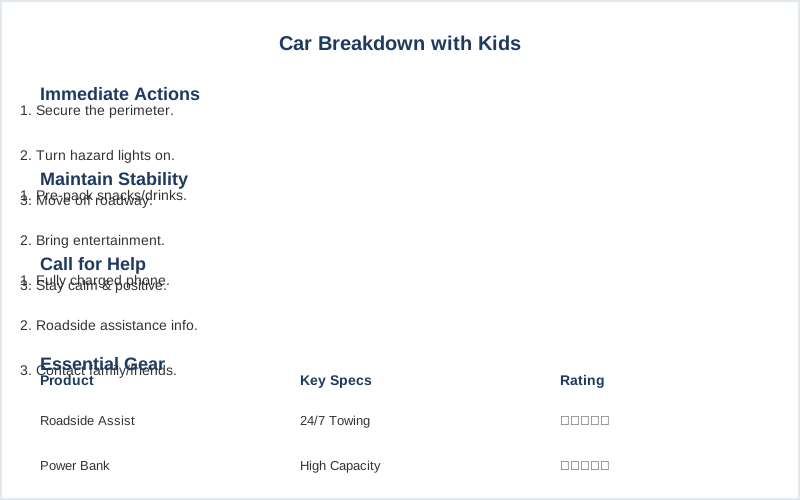
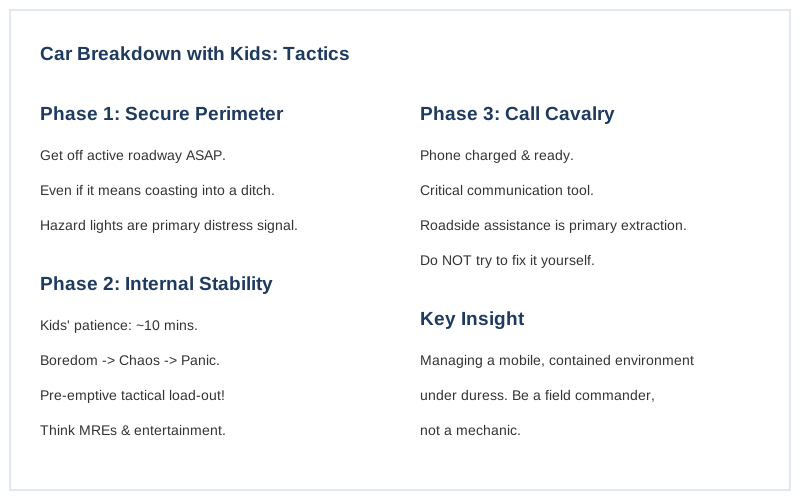
When your vehicle decides to become a very expensive lawn ornament, your first priority is securing the perimeter. This means getting off the active roadway immediately, even if it means coasting into a ditch. A static vehicle on a highway is a target, not a safe haven. Turn those hazard lights on; they're your primary distress signal.
Your secondary objective is maintaining internal stability. Kids, especially young ones, have a half-life of about 10 minutes before boredom turns into chaos, which then metastasizes into full-blown panic. This requires a pre-emptive tactical load-out, not wishful thinking. Think MREs and entertainment, not organic fruit snacks.
The final phase is calling in the cavalry. This isn't the time to consult your owner's manual or try to MacGyver a fix. Your phone, charged and ready, is your most critical piece of communication equipment. Roadside assistance is not a luxury; it's your primary extraction protocol.
Without it, you're looking at a 3-hour wait for a tow truck that charges $150 minimum for a short haul, plus the psychological damage of trying to explain 'why we're stopped' for 180 minutes.

The Reality Check
The reality of a breakdown is rarely a dramatic explosion. It's usually a slow, insidious failure that gives you just enough warning to panic, but not enough to fix it. Your car's systems are interconnected; one failure often cascades, turning a minor issue into a major headache. For example, a dying battery doesn't just stop the car; it can kill power steering and brakes in some vehicles, turning a simple stop into a wrestling match. Visibility is key.
Maintaining situational awareness is critical. What's the ambient temperature? How much fuel is in the tank? How many hours until sunset? These aren't minor details; they dictate your survival window. A dead battery on a 90-degree F day with no AC means a 30-minute window before heatstroke becomes a threat, especially for small children.
| Component | How It Fails | Symptoms | Fix Cost |
| Battery | Internal cell degradation, sulfation | Slow crank, dim lights, no start | $120-$250 |
| Alternator | Diode failure, bearing seize | Battery light on, dimming lights, eventual stall | $400-$800 |
| Tire | Puncture, sidewall blowout | Rapid deflation, vibration, steering pull | $150-$300 per tire |
| Fuel Pump | Electrical failure, clogged filter | Engine sputtering, no start, loss of power | $500-$1200 |
Understanding these failure points isn't about becoming a mechanic. It's about knowing the threat level. A flat tire is a contained event; an alternator failure is a ticking clock. Your insurance often covers roadside assistance for these common failures. Don't underestimate the cascading effect of a single component failure.
How to Handle This
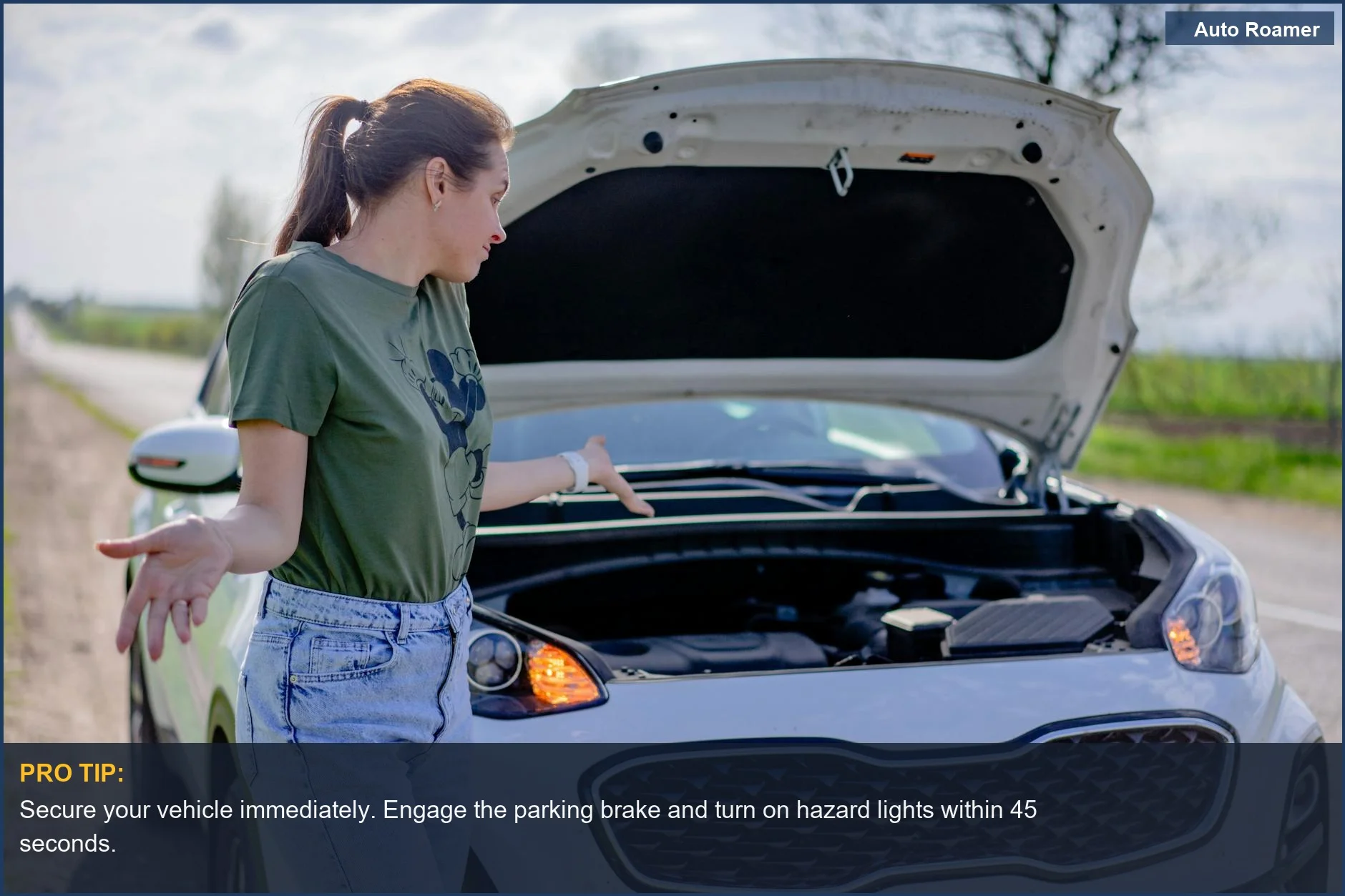
When your vehicle goes silent, your first action is not to panic, but to execute the immediate containment protocol. You have approximately 45 seconds to get off the road. Use your momentum; don't slam the brakes. Aim for the shoulder, an exit, or a parking lot - anywhere away from active traffic.
-
Secure the Vehicle Perimeter: Once stopped, activate hazard lights. If safe, turn the wheels away from the road and engage the parking brake. This prevents your vehicle from drifting into traffic. Your survival depends on making your presence known without becoming a projectile.
-
Assess Internal Threats: Check on the kids. Are they calm? Are they secured? This is where your pre-packed sanity-saver kit comes in. Distraction is a powerful weapon against escalating panic. Keep your phone charged.
-
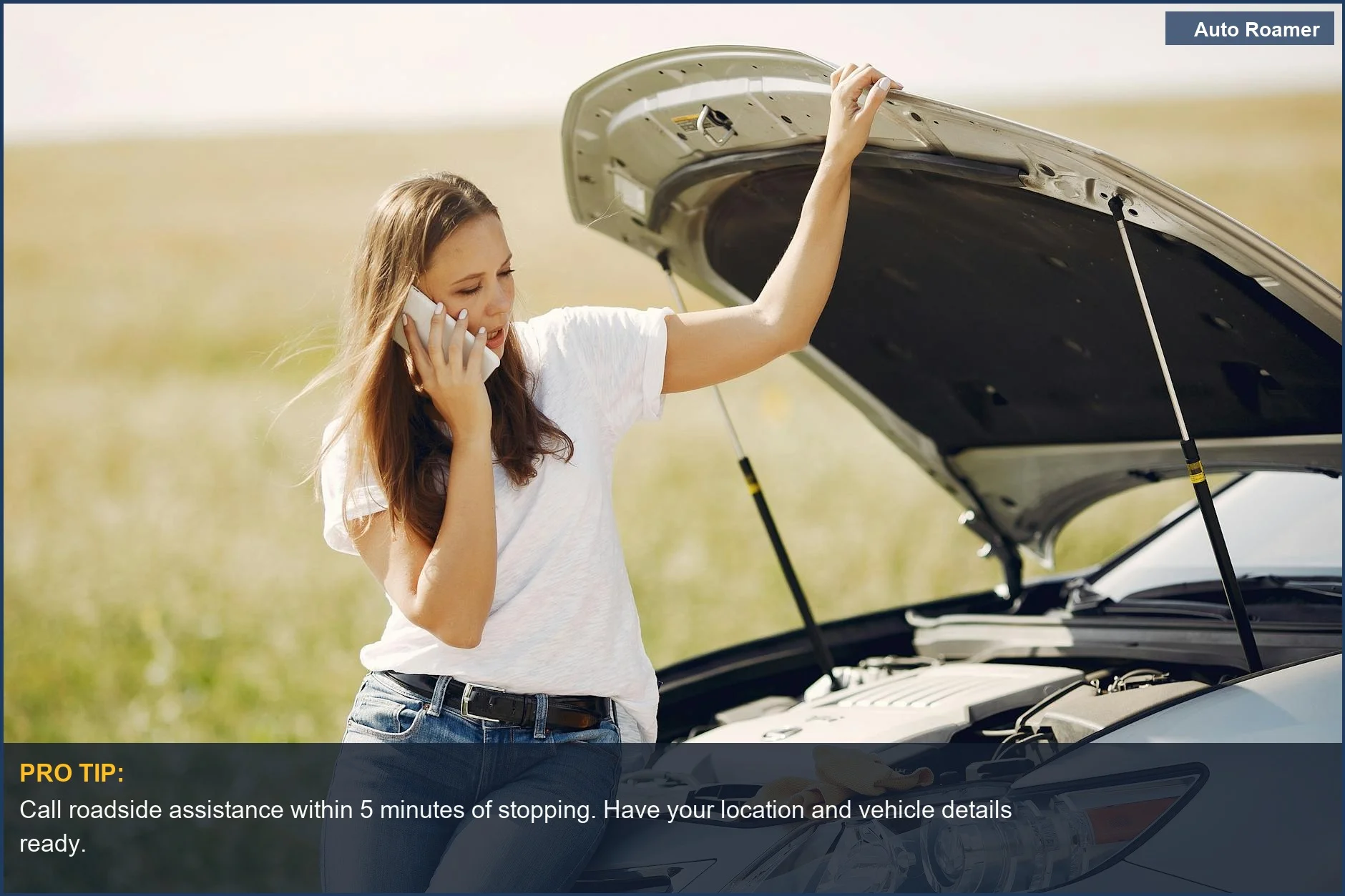
Initiate Communication Protocol: Call roadside assistance immediately. Provide your exact location (use GPS coordinates if possible), vehicle make/model, and a concise description of the failure. Do not try to diagnose or fix the issue yourself; that's for the professionals. A good roadside assistance plan costs $60-$120 annually and is a non-negotiable part of your load-out.
-
Enhance Visibility: If safe to exit the vehicle (passenger side, away from traffic), deploy reflective triangles or flares 100-200 feet behind your car. This provides an early warning system for oncoming traffic. If you don't have these, you're operating at a significant tactical disadvantage. A basic kit costs $20.
-
Maintain Containment: Stay inside the vehicle with seatbelts fastened, especially on a busy highway. Do not accept help from strangers. Your only objective is to keep your crew safe until professional extraction arrives. This is not a social call; it's a hazmat situation.
What This Looks Like in Practice
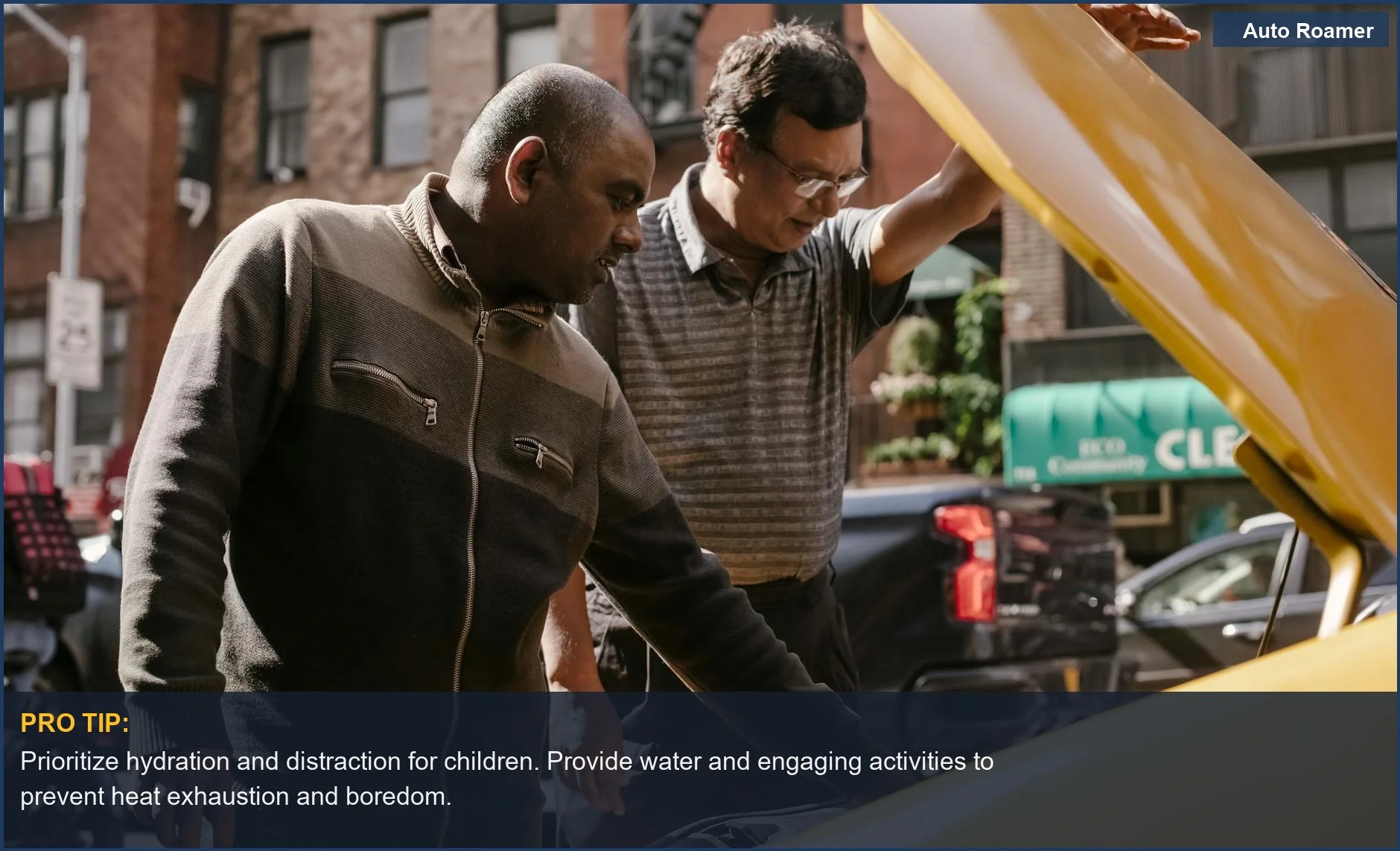
A 2007 Honda Odyssey, 150,000 miles, on I-70 at 3 PM, 95 degrees F, with a 3-year-old and a 5-year-old. The alternator dies. No AC. You have 30 minutes before heat exhaustion becomes a real threat for the kids. The containment protocol demands immediate hydration and distraction, plus an urgent call to roadside assistance. Remaining calm is easier said than done.
A flat tire on a suburban street at 10 AM with a sleeping infant. Threat level: low. You have a 45-minute window before the infant wakes up. Your load-out includes a compact stroller for an immediate transfer to a nearby park or safe public space while you wait for assistance. This mitigates the risk of a screaming infant in a hot car.
Engine overheating on a rural road, 8 PM, 40 degrees F, two pre-teens. The vehicle is unsafe to drive. Your tactical load-out includes blankets, extra layers, and a fully charged power bank for devices. Entertainment is critical to prevent boredom-induced arguments. You're looking at a 2-hour minimum wait for a tow in this remote area.
A dead battery in a grocery store parking lot. Threat level: minimal, but the kids are hungry. This is a 20-minute fix with jump cables or a portable jump starter. Your load-out includes emergency snacks. The main risk is a delayed dinner, which can trigger a Code Red meltdown. Prioritize the food. A $50 jump pack saves you a $90 tow.
Mistakes That Cost People
| Mistake | Consequence | Mitigation |
| Ignoring warning lights | Catastrophic failure, stranding | Address immediately, schedule diagnostic |
| No roadside assistance | Extended wait, exorbitant tow fees ($150-$500) | Enroll in AAA or similar plan ($60-$120/year) |
| Exiting on busy highway | High risk of secondary accident, injury | Stay inside, unless absolutely safe to exit |
| Uncharged phone | Loss of communication, delayed help | Always carry a power bank and charger |
| No emergency kit | Dehydration, boredom, escalating meltdowns | Pack water, snacks, first aid, entertainment |
| Attempting DIY fixes | Further damage, safety risks, delays | Call professionals, provide clear details |
Ignoring a 'check engine' light is not optimism; it's negligence. That light is a 24-hour warning before a minor issue becomes a $1,000 repair and leaves you on the side of the road. Resist the urge to slam on the brakes.
Trying to change a tire on a busy interstate shoulder is a suicide mission. The wind blast from a semi-truck at 70 mph can knock you off your feet. Your kids are safer inside the vehicle while you wait for a professional extraction. Your life is worth more than a $20 tire change fee.
Not having a fully charged phone is akin to entering a combat zone without a radio. Communication is your lifeline. A dead phone means you're isolated, vulnerable, and the extraction time doubles. That's a minimum 3-hour wait turning into 6 hours. This is not a drill.
Key Takeaways
When your vehicle fails, your primary mission is biohazard containment and logistic survival. This isn't about 'being prepared' in a vague sense; it's about a specific load-out and a drilled extraction protocol. Emergency kits are not optional.
Key takeaways:
- Prioritize Safety: Get off the road immediately. Turn on hazard lights. This is non-negotiable.
- Contain Internal Threats: A well-stocked emergency kit (water, snacks, entertainment, first aid) is your sanity-saver. It buys you time.
- Secure Extraction: A paid roadside assistance plan (AAA, insurance add-on) is your fastest, safest path to resolution.
It's a $60-$120 annual investment that pays for itself the first time you use it. * Stay Put: Remain in the vehicle, seatbelts fastened, unless it's absolutely safe to exit. Do not engage with strangers offering help. * Communicate Clearly: Have your phone charged. Provide precise location and vehicle details to assistance. This reduces extraction time by 30 minutes minimum.
This isn't about luck; it's about planning. A breakdown with kids is a tactical operation, and you're the commander.
Frequently Asked Questions
Is it really worth paying $100 a year for roadside assistance when I can just call a local tow truck for $150 if I break down?
Do I actually need reflective triangles and flares, or can I just use my hazard lights?
What if my phone dies and I can't call for help?
Can leaving my kids in the car with the engine off on a hot day really be dangerous if it's only for an hour?
Is it true that if my car breaks down, I should always try to get it started again as soon as possible?
Sources
- No family or friends what am I supposed to do if my car ...
- Let's talk Road safety! I am sitting behind my kids car broke ...
- What to Do If Your Car Breaks Down: Tips for Roadside Safety
- Stranded On The Road With Toddlers - Tips For A Road-Trip ...
- Tips on What To Do if Your Car Breaks Down - State Farm®
- What To Do When Your Car Breaks Down During An EI Visit
- What to Do When Your Car Breaks Down (7-Steps) - Allstate
- Speak Up for Kids - What to Do When Your Car Breaks Down
- What to Do in Case of a Breakdown A Step-by-Step Guide - Rad Air
- What to Do When Your Car Breaks Down on the Highway