
What to Do If Car Breaks Down With Kids on Road Trip (2026 Complete Guide)
A blown tire on a desolate stretch of I-70 at 2 AM with two toddlers in the backseat? That's not a 'bad day,' that's a full-scale biohazard containment failure. You have exactly 45 minutes before the internal temperature of the vehicle becomes a liability, and exactly 90 seconds before 'I'm bored' escalates to a Code Red meltdown.
A blown tire on a desolate stretch of I-70 at 2 AM with two toddlers in the backseat? That's not a 'bad day,' that's a full-scale biohazard containment failure. You have exactly 45 minutes before the internal temperature of the vehicle becomes a liability, and exactly 90 seconds before 'I'm bored' escalates to a Code Red meltdown.
I learned this the hard way on a summer drive through Kansas, where the nearest town was 30 miles away and the only thing open was a gas station with questionable coffee. My load-out now ensures I never repeat that particular extraction nightmare. You're not just driving; you're operating a mobile command center, and preparedness is your only sanity-saver. AAA recommends carrying an emergency kit, and I'm here to tell you why it's non-negotiable.

The Short Answer
Most breakdowns with kids on board become critical not because of the mechanical failure itself, but because of the cascading failures in your support systems. Your car stopping is just the first domino. The real disaster is the lack of potable water, the absence of a waste containment strategy, and the 4-hour delay until a tow truck arrives. Being stranded with toddlers in the dark is a logistical nightmare.
The mental model here is a field operation. You are the commander. Your mission is to maintain the internal environment of your vehicle and its occupants until external support arrives. This means having a pre-staged load-out for every contingency, because 'hoping for the best' is a tactical error that costs time and money. The Reddit thread "Drive the car until it falls apart" hits different when you have kids highlights the shift in priorities.
Kids don't care about your engine's internal combustion cycle. They care about their next snack, their bladder capacity, and the ambient temperature. Their biohazard potential increases exponentially with discomfort. A breakdown transforms your car into a static, exposed position, and your primary goal becomes securing that position and its occupants. Without a plan, you're not just broken down; you're vulnerable. My goal is to prevent you from ever having to abandon ship.

The Reality Check
A vehicle breakdown isn't a singular event; it's a series of cascading failures, each with its own threat level. Ignoring minor symptoms before a trip is like ignoring a ticking time bomb. The small vibration in your steering wheel at 60 MPH isn't just a nuisance; it's a 3-hour delay on the side of the highway waiting for a flatbed. Preventative maintenance is your first line of defense.
I once drove a 2008 Honda CR-V that developed a faint squeal. I ignored it for two weeks. That squeal became a seized water pump on a 100-degree F day, 80 miles from the nearest town. The repair was $600. The tow was $150. The emergency hotel room with two overheated kids was $120. Total cost of ignoring a $100 preventative fix? $870 and 14 hours of lost time. That's a debriefing you don't want to have.
My field-tested protocol: know your vehicle's common failure points. Understand the symptoms, the repair window, and the logistical impact. This isn't about being a mechanic; it's about being a tactical planner. The goal is to avoid the scenario where you are stranded on the road with toddlers.
| Component | How It Fails | Symptoms | Fix Cost (Est.) |
|---|---|---|---|
| Tires | Puncture, blowout, low pressure | Vibration, pulling, loud bang, TPMS light | $150-$300 per tire |
| Battery | Age, extreme temps, parasitic drain | Slow crank, no crank, dim lights, warning light | $120-$250 |
| Cooling System | Hose burst, radiator leak, water pump failure | Overheating, steam, coolant leak, warning light | $300-$1000 |
| Alternator | Worn bearings, rectifier failure | Battery light, dimming lights, eventual dead battery | $400-$800 |
| Fuel System | Clogged filter, failing pump | Stalling, sputtering, no start, check engine light | $200-$1000+ |
Each of these failures has a specific half-life before it becomes a full-blown crisis. A low tire pressure warning gives you 20-30 minutes to find air before it becomes a sidewall blowout. An overheating engine gives you 5-10 minutes to pull over before permanent engine damage. Knowing these windows is critical for a successful extraction. This isn't about being paranoid; it's about understanding the operational parameters of your equipment.
How to Handle This
-
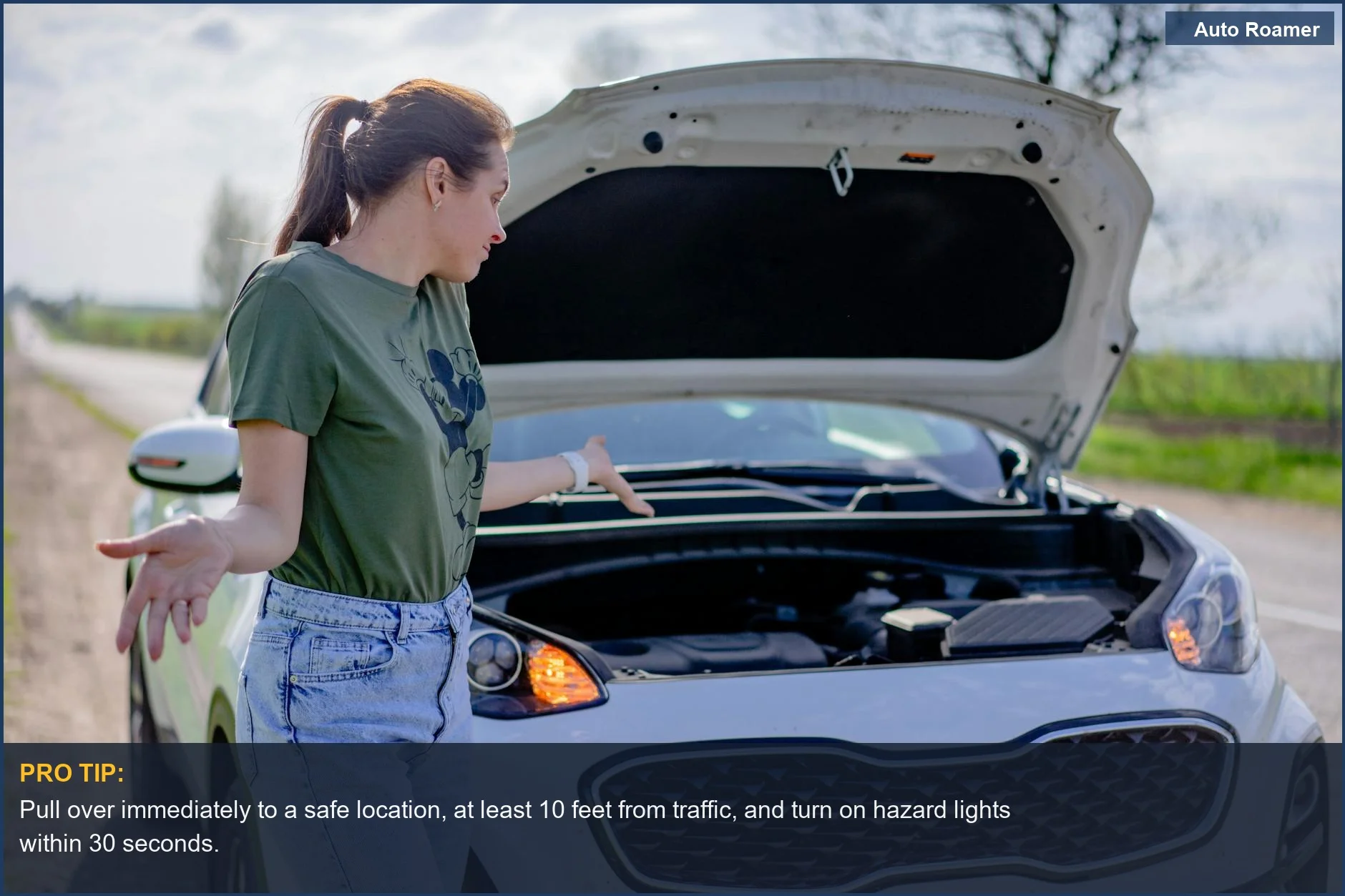
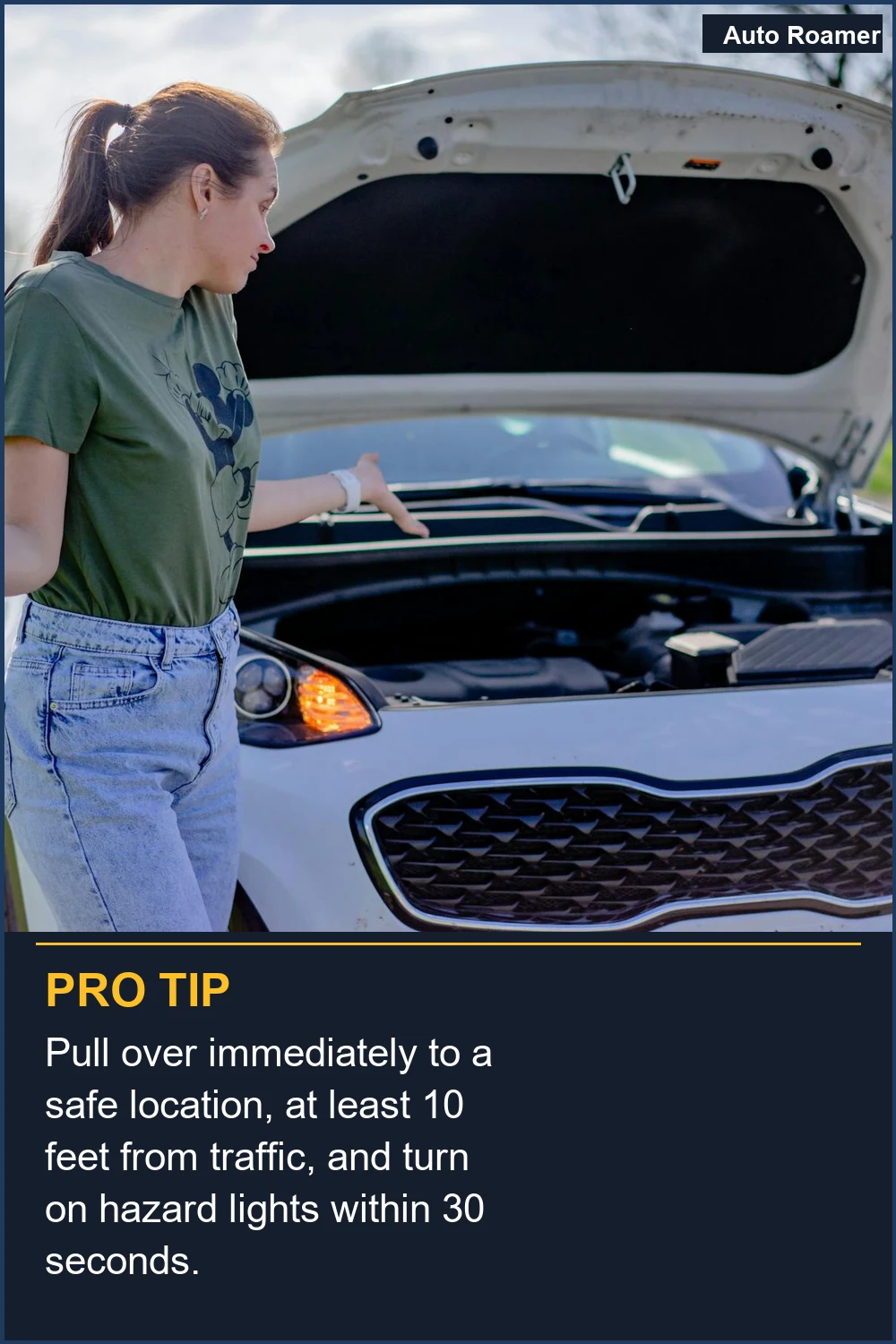
Secure the Perimeter (Immediately): The moment you detect a failure, activate your hazard lights. This is non-negotiable. Begin a controlled deceleration and maneuver to the safest possible location. This means off the main roadway, preferably on a flat, stable surface. Quora users advise getting to the side of the road, and I agree.
-
Contain the Cargo (1 minute): Once stopped, engage the parking brake and turn the wheels away from traffic. This prevents accidental rolling. Now, for the critical part: deploy your kid containment strategy. This means snacks, water, entertainment tablets, and the pre-loaded gallon ziplock bags for biohazard waste. My load-out includes two full water bottles per child, a bag of goldfish crackers, and a fully charged Kindle Fire loaded with 3 hours of content.
This buys you a crucial 30-minute window of relative calm. Using hazard lights is just the start.
-
Assess the Threat (5 minutes): Do a quick visual inspection if it's safe. Is there smoke? Leaking fluids? A flat tire? This isn't about fixing it yourself, it's about gathering intelligence for the rescue team. Do NOT leave the immediate vicinity of the vehicle if you're on a busy highway. Your priority is internal security.
-
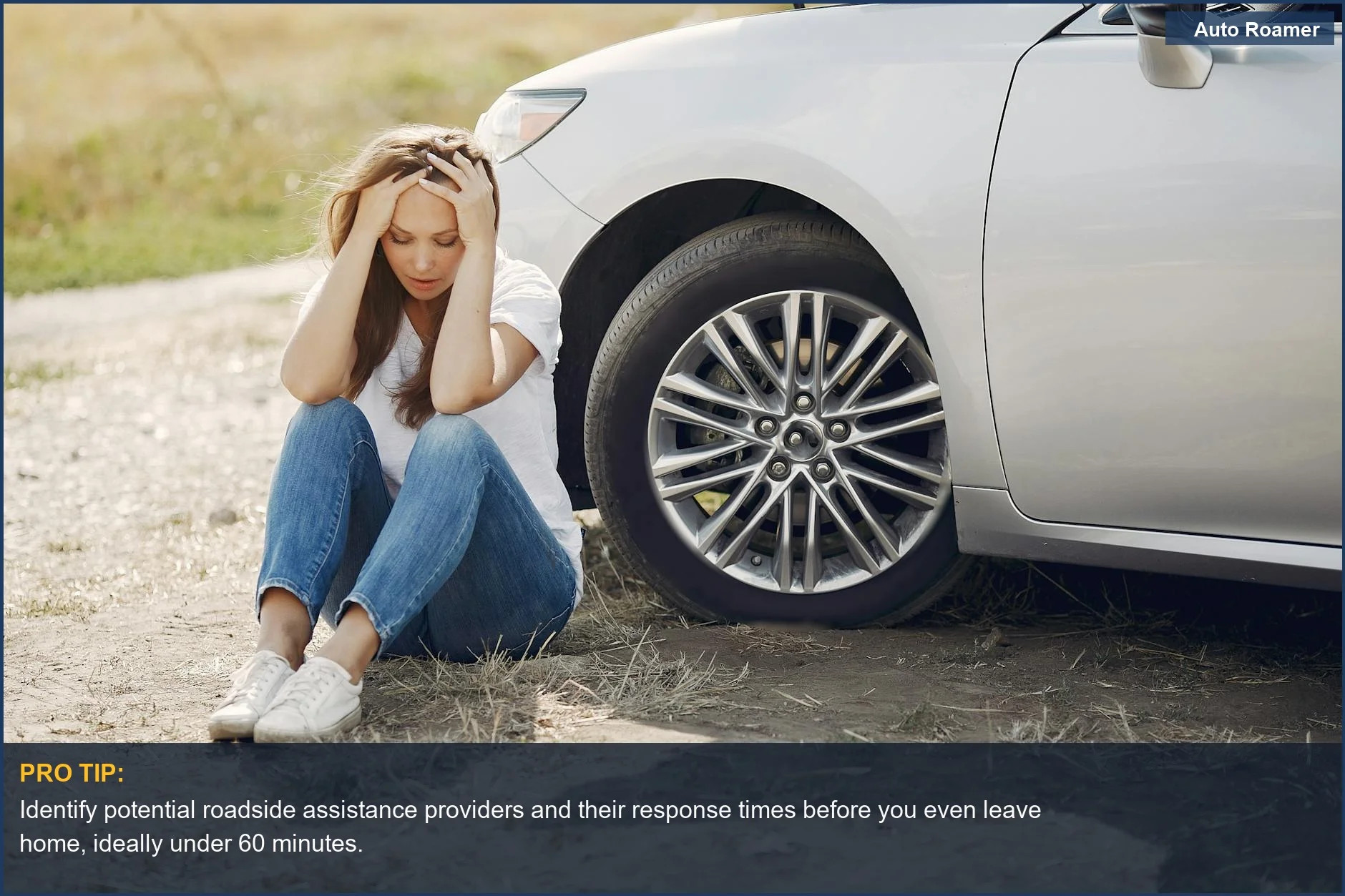
Initiate Extraction Protocol (Roadside Assistance - 5 minutes): This is where your roadside assistance membership becomes your most valuable asset. My tactical load-out includes a AAA Premier membership costing $129/year. This provides 200 miles of towing, which is non-negotiable for a road trip. Without it, a 50-mile tow can cost $200-$300 out of pocket. Call them immediately. Have your location, vehicle info, and a brief description of the issue ready.
-
Options:
- Roadside Assistance Membership: AAA, your car insurance, or a manufacturer's plan. Crucial for pre-paid, reliable service. They vet their tow operators.
- Credit Card Benefits: Some premium credit cards offer roadside assistance. Check your benefits guide for specific coverage and limits.
-
Independent Towing: A last resort. You'll pay full price, and quality can vary wildly. Always get an upfront quote. Be aware that some areas have predatory towing practices.
-
Questions to Ask:
- "What's the estimated arrival time?" (Critical for managing kid-related meltdowns)
- "What's the tow limit in miles?"
- "Is there a preferred repair facility in the area, or can I choose?"
-
"What are the options for a rental car if the repair takes longer than a day?"
-
Maintain Internal Environment (Ongoing): Keep the kids calm. Continue deploying snacks and entertainment. Monitor their hydration and comfort levels. This is your primary mission until the cavalry arrives. Your sanity depends on their stability.
What This Looks Like in Practice
The 2017 Subaru Outback with the blown serpentine belt 60 miles from Flagstaff at 3 PM, 105 degrees F. Two kids, ages 4 and 6. Initial threat level: high. Action: Pulled over, deployed sunshades, started the iPad. Called AAA. ETA 90 minutes. Result: Kids watched 'Frozen 2' twice, drank all the water. Tow to Flagstaff, $800 repair bill, one night in a hotel ($140). Total time lost: 18 hours.
Without the iPad and water, that 90 minutes would have been a Code Brown.
My 2012 Ford F-150, flat tire on a rural highway in Iowa at 10 AM. Two teenagers, ages 13 and 15. Initial threat level: moderate. Action: Pulled over, deployed safety cones, got out the spare. Teenagers were tasked with finding streaming service-compatible Wi-Fi on their phones. Result: Tire changed in 20 minutes. Teenagers found a signal, complained about data usage. Minimal logistical impact. Saved $120 roadside tire change fee by doing it myself.
The 2015 Toyota Sienna, 'check engine' light on in the middle of nowhere, Texas, at 7 PM. One toddler, one infant. Initial threat level: severe. Action: Pulled over at the next exit, found a well-lit gas station. Called a mobile mechanic service. Result: Code read as a faulty oxygen sensor, drivable but inefficient. Mechanic advised driving to the next large town. No tow needed, $150 for the diagnostic.
Hotel for the night ($110) because driving at night with a compromised vehicle and two tiny humans is a tactical error. Sanity-saving tips are essential.
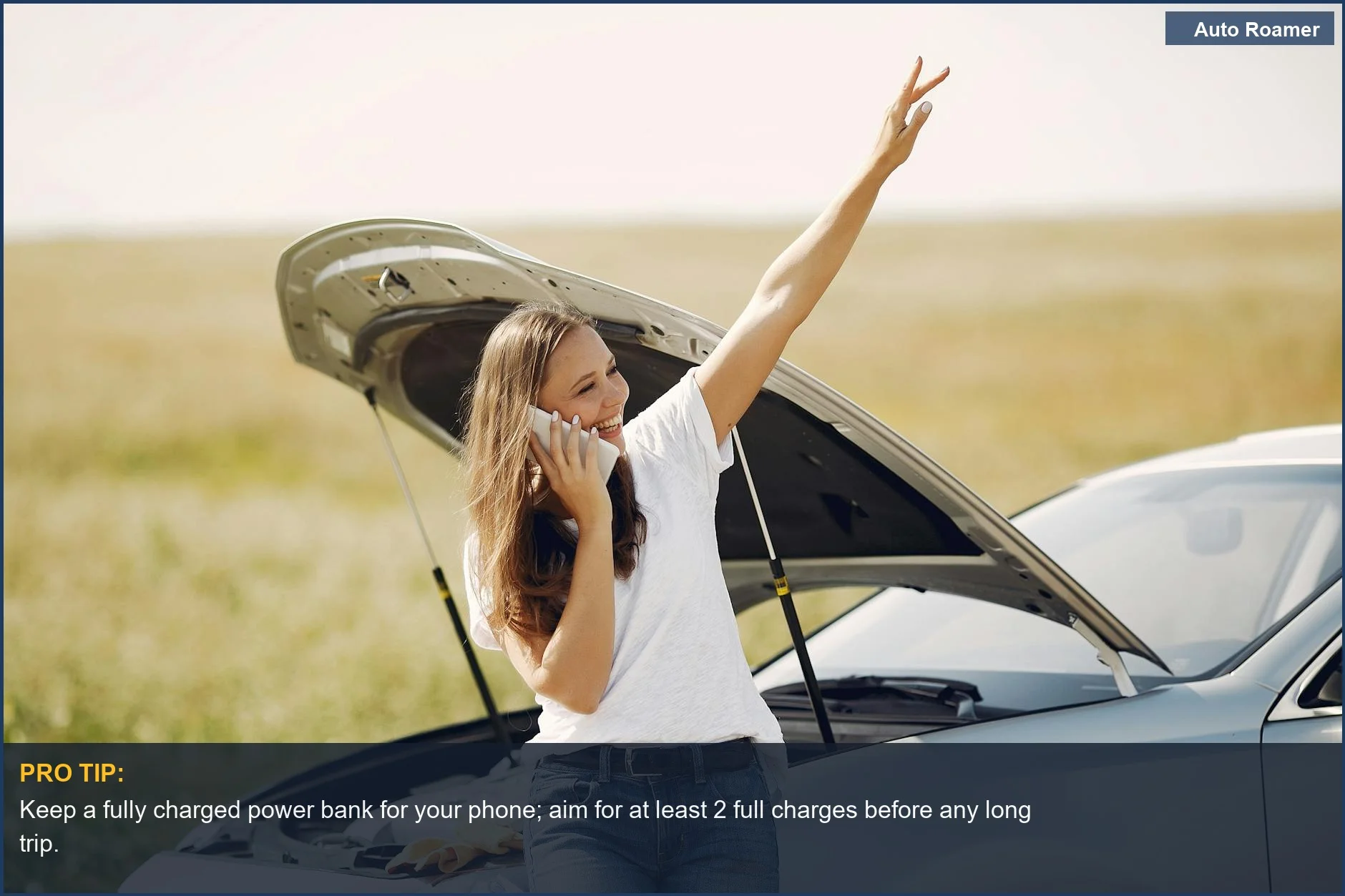
My sister's 2010 Nissan Altima, dead battery in a rest stop in Ohio at noon. Three kids, ages 7, 9, 11. Initial threat level: low. Action: Attempted jump start with another driver, failed. Called roadside assistance. Result: Battery replaced on the spot for $180. 45-minute delay. Kids played tag. Minimal disruption. This is why a charged power bank is in my kit - for their phones, not just mine.
Knowing basic car repairs can make a difference, but not always.
Mistakes That Cost People
| Mistake | Consequence | Correction |
|---|---|---|
| Ignoring pre-trip inspection | Increased likelihood of critical failure, 100% higher tow costs. | $50 preventative check-up saves $500+ in roadside repairs. |
| No roadside assistance | Minimum $150 for a short tow, 3-hour wait for a non-priority service. | $129/year membership for guaranteed service, often with rental car benefits. |
| Lack of kid entertainment/snacks | Exponential increase in internal biohazard threat level, 60-minute meltdown window. | Pre-loaded tablets, water, non-perishable snacks in a $15 cooler. |
| Exiting vehicle on busy highway | High risk of secondary accident, potential for severe injury. | Stay inside, hazard lights on. Only exit if safe and absolutely necessary. Allstate advises staying inside. |
| Relying solely on phone for help | Dead battery means no communication, 8 hours stranded. | Portable battery bank, physical map, emergency cash ($50 minimum). |
| No emergency waste containment | Permanent odor contamination of vehicle, $180 interior detail. | Gallon ziplocks, plastic bags, baby wipes within arm's reach. |
Failing to conduct a pre-trip vehicle inspection is a rookie mistake. You're voluntarily deploying into a hostile environment without checking your gear. That $50 oil change and fluid check could flag a worn belt or a leaking hose, saving you hundreds in emergency repairs. My mechanic once found a nail in my tire sidewall during a pre-trip check, preventing a blowout. That's not luck; that's tactical planning.
Assuming your phone will always have service and battery is a critical flaw in your operational plan. Remote areas exist. Dead zones are real. A dead phone battery is a complete loss of communication, escalating your threat level from inconvenience to full-blown isolation. Always have a backup power source and a physical map. Your GPS can die. Your sanity cannot.
Key Takeaways
When your car breaks down with kids, the mission shifts from travel to survival. Every minute counts, and every item in your load-out is a piece of your sanity-saver. My field-tested approach prioritizes containment and swift extraction to minimize the logistical fallout. Children's Mercy emphasizes preparedness for road trips, and they're not wrong.
- Pre-Trip Inspection: A non-negotiable $50 investment that prevents $500+ in roadside disasters.
- Roadside Assistance: A $129/year membership is cheaper than a single 50-mile tow. It's not optional; it's essential.
- Kid Containment Load-out: Pre-staged snacks, water, entertainment, and biohazard bags buy you critical time and prevent meltdowns. My rule: 3 hours of content, 2 liters of water, and 1 gallon ziplock bag per child.
- Safety First: Remain in the vehicle unless it is absolutely unsafe.
Hazard lights on, wheels turned away. Your safety is paramount. * Communication Backup: Don't rely solely on your phone. A portable power bank and a physical map are critical for maintaining contact and situational awareness.
Remember, you're not just driving; you're commanding. Prepare for the worst, and you'll navigate the unexpected with minimal chaos. My car interior is a high-traffic zone, not a museum. Your mission: keep it that way.
Frequently Asked Questions
Is it really worth buying a dedicated tire plug kit for $25, or should I just wait for a professional if I get a puncture?
Do I actually need to carry a jump starter pack, or will jumper cables and hoping for a good Samaritan work?
What if my kids still have a meltdown even with the full entertainment load-out and snacks?
Can leaving a car broken down on the side of the highway for too long result in it being impounded?
My uncle says I just need a basic tool kit. Is that enough, or do I need more specialized gear?
Sources
- Stranded On The Road With Toddlers - Tips For A Road-Trip ...
- How to Survive a Road Trip With Kids - Your AAA Network
- What should you do if your car breaks down during a road trip in the ...
- The ultimate guide to road-tripping with kids - Children's Mercy
- How to handle car breakdowns in the middle of a trip ... - Quora
- Stranded On The Road With Toddlers - Tips For A Road-Trip ...
- What to Do When Your Car Breaks Down (7-Steps) - Allstate Insurance
- "Drive the car until it falls apart" hits different when you have kids
- What To Do If Your Car Breaks Down On A Road Trip - Endurance
- How to prevent and handle car breakdowns during road trips?
- Planning a road trip with kids? These sanity-saving tips ... - Reddit